Acquisition Integration: What Drives Deal Value
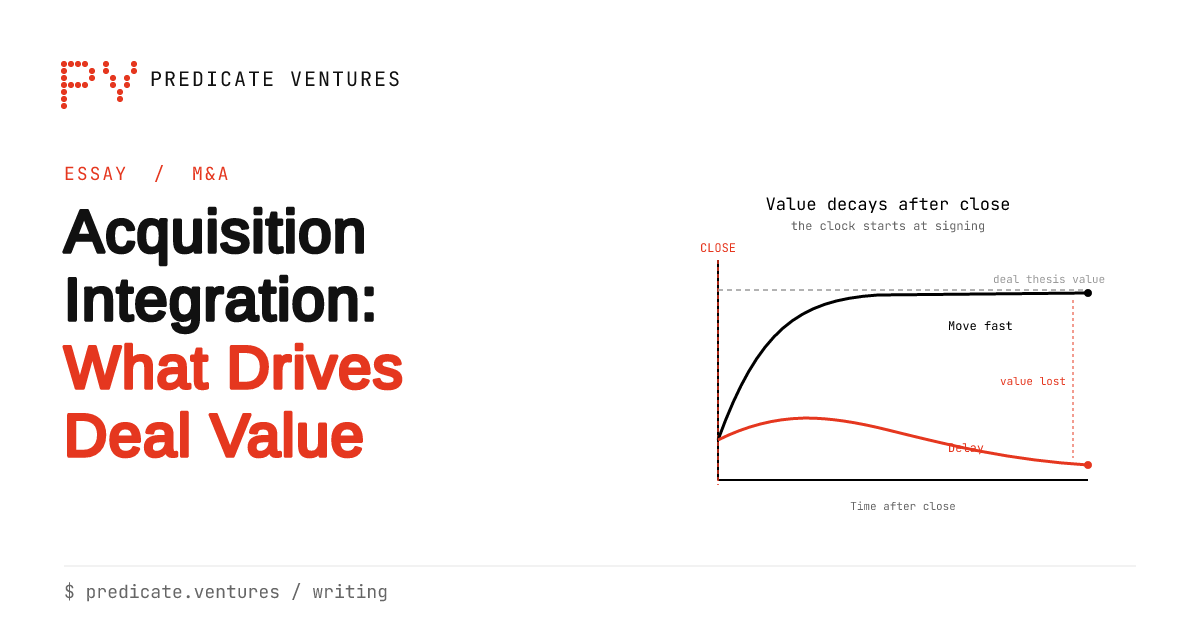
Integration is where deal value is made or lost—and the clock starts at close.
Blake Aber · Predicate Ventures · 2026
The deal is the easy part
Signing a purchase agreement generates headlines. Capturing the value that justified the price generates returns. The gap between the two is acquisition integration, and it is where most deals succeed or fail.
The environment favors buyers who move. Global M&A activity in 2025 rose 40% in value to an estimated $4.9 trillion, putting it on track to be the second-highest year on record for deal activity (Bain). More deals means more integrations competing for the same management attention.
Speed is the strongest predictor
The single clearest signal in the research is timing. A deal is 2.6 times more likely to succeed, and delivers 40% more total returns to shareholders, when synergy targets are met within the first two years post-close rather than taking more than four (McKinsey).
Early momentum compounds. Companies that outperformed the market index over the life of a deal captured a run rate equal to 50 percent of their public synergy target in the first year alone (McKinsey).
The problem is that the runway before close keeps shrinking usable time. The median lag between signing and closing has stretched to about 6.4 months, a 25% increase over 20 years ago, and nearly one in six transactions now takes over a year to close (McKinsey).
That delay is not idle time. It is a window in which integration planning can happen—if the acquirer uses it well.
Plan before you can act
Antitrust and regulatory rules limit what two companies can share before close. Merging teams cannot pool commercial data or coordinate as one organization while the deal is pending.
The consequence of ignoring those limits is severe. The European Commission can fine companies up to 10% of revenue for gun-jumping, and it imposed that maximum on Illumina for closing its acquisition of Grail without approval (BCG).
Clean teams—separate groups of employees or third parties authorized to review sensitive information under legal protocols—let acquirers build detailed integration plans during the pre-close window without breaking the rules. When close finally arrives, the plan is ready to run rather than starting from scratch.
Protect the base business
Integration attention often flows to cost cutting and org charts. Meanwhile the acquired revenue quietly erodes.
Acquirers typically see sales decline eight percent in the quarter after announcing a deal (McKinsey). Customers hear about the change, competitors call them, and salespeople worry about their jobs. Left unmanaged, that dip becomes permanent.
Protecting existing revenue is the first job of integration. Retention plans for key accounts and salespeople, clear commercial ownership, and fast decisions on product overlap all matter before any synergy math pays off.
Synergies are bigger than the model
Most deals are priced against a synergy estimate built during due diligence. Treating that number as the ceiling leaves value on the table.
Looking for sources of value beyond what justified the deal—what McKinsey calls opening the aperture—can increase synergies by 30 to 150 percent above due-diligence estimates (McKinsey). The diligence model was built under time pressure with limited access. Once the two companies are combined, the real opportunities become visible.
Revenue synergies are the hardest to capture and the most sensitive to leadership. Between 70 and 80 percent of mergers that met or exceeded their revenue-synergy goals had strong senior-leadership involvement from the CEO down to sales (McKinsey). Cost synergies can be driven from a spreadsheet. Revenue synergies require executives to show up and set direction.
The case for doing this repeatedly
Integration skill is a muscle, and companies that use it often get stronger. The advantage of frequent acquirers is widening.
Bain found the gap in total shareholder returns between frequent acquirers and inactive companies was 130% between 2012 and 2022, up from 57% between 2000 and 2010 (Bain).
A disciplined, repeatable approach outperforms occasional large bets. The median excess return for companies using programmatic M&A was 2.1 percent over ten years, meaning they beat their peer groups by at least 20 percent in total shareholder return (McKinsey).
The reason is straightforward. Serial acquirers build integration into an operating capability—standard playbooks, dedicated teams, known metrics—rather than reinventing the process each time.
What a working integration looks like
The patterns in the research point to a short list of practices that separate deals that create value from those that erase it.
Start planning before close
Use the pre-close window and clean teams to build a plan that can execute on day one, without crossing regulatory lines.
Set a fast synergy timeline
Aim to hit synergy targets inside two years, and structure early wins in the first twelve months to build momentum and credibility.
Defend the revenue base
Assume an eight percent sales dip is the default outcome and build retention and communication plans to prevent it.
Put leaders on revenue synergies
Cost synergies can be delegated. Revenue synergies need visible, sustained involvement from senior leadership.
Look past the diligence model
Treat the deal thesis as a floor. Once combined, hunt for value the original model could not see.
The bottom line
Acquisition integration is not the administrative work that follows a deal. It is the phase where the price paid becomes either a return or a loss.
The data is consistent across sources: speed, protected revenue, engaged leadership, and repeatable discipline are what turn a signed agreement into a successful acquisition. Deals fail slowly, in the months after close, long after the announcement fades.