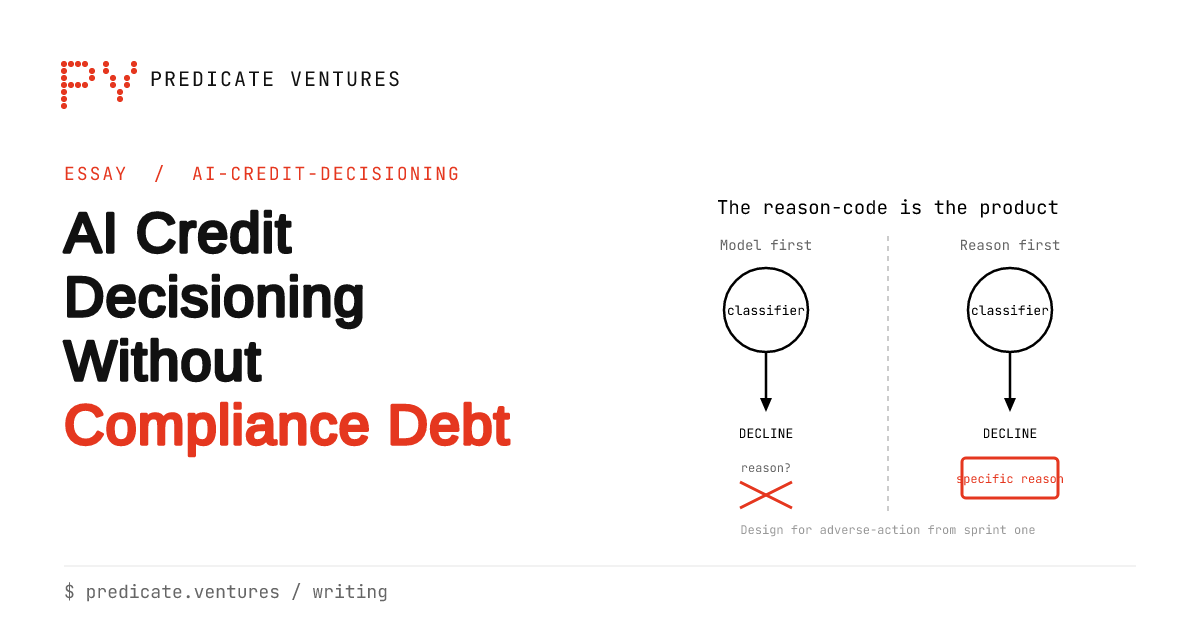
AI Credit Decisioning Without Compliance Debt
An AI credit model is only shippable if it can explain, on demand, the specific reason it declined any single applicant.
Blake Aber · Predicate Ventures · 2026
Most teams build the model first and bolt on compliance later. That order is backwards, and it generates debt that compounds every time the model retrains.
In credit, the regulator does not care how accurate your classifier is. It cares whether a declined applicant received a specific, truthful reason within a fixed window. Design for that constraint from the first sprint and the rest of the system falls into place.
The rule you cannot engineer around
Under the Equal Credit Opportunity Act and its implementing Regulation B, a creditor that declines an application must send an adverse action notice stating the specific principal reasons for the decision. The CFPB has made clear this applies no matter how complex the underlying model is.
The agency's 2022 circular states plainly that creditors using complex algorithms, machine learning or AI are not exempt, and that disclosing only the key factors that lowered a credit score does not satisfy the requirement (Consumer Financial Protection Circular 2022-03).
There is no carve-out for opacity. If your model cannot produce a specific reason, the model is not compliant, regardless of how well it predicts default.
"Close enough" reasons fail
Teams often reach for a sample-form denial reason that approximates what the model did. The CFPB closed that door.
Guidance states a creditor cannot select the sample reason closest to the actual one, and cannot point to a broad bucket. It must identify and disclose the actual, specific reasons for the denial (CFPB guidance on AI credit denials).
This matters most for models trained on alternative data or engineered features that have no clean human-readable label. If a feature drove a decline but you cannot translate it into a concrete, accurate reason, that feature is a liability.
Scope the reasons to what the model actually scored
Regulation B adds a boundary in the other direction too. When a denial rests on a credit scoring system, the disclosed reasons must relate only to factors the system actually scored, and no factor that was a principal reason may be excluded (§ 1002.9).
So the reasoning output has to be both complete and honest. You cannot omit a factor that mattered, and you cannot invent one that did not.
Build explainability into the decision path
The practical consequence: reason generation is part of the model's output, not a downstream report.
Every decision should emit the prediction and the ranked contributing factors in the same transaction. Treat the reason codes as a first-class artifact the model is responsible for producing, with the same test coverage as the score itself.
Constrain the feature space to explainable inputs
The cheapest way to avoid untranslatable reasons is to not use untranslatable features. Before a feature enters the model, require a human-readable mapping to a lawful, specific reason.
If a feature cannot be mapped, it does not ship. This keeps the reason-generation problem tractable and prevents a high-performing feature from becoming a compliance failure after launch.
Validate reasons against the actual decision
An explanation that does not reflect the real drivers is worse than no explanation. Build a validation step that checks each generated reason set against the model's attribution for that specific applicant.
When the two diverge, the decision should be held, not sent. A held decision is a problem you can fix before a notice goes out; a wrong notice is a problem you fix in front of a regulator.
Timing is a system requirement
Regulation B sets clocks. Notice of the action taken is due within 30 days of a completed application. If the applicant requests the statement of specific reasons, the notice must disclose their right to request those reasons within 60 days (Appendix C to Part 1002).
Design the pipeline so the reason set is generated at decision time and stored, not reconstructed weeks later. Reconstructing a reason from a retrained model is a recipe for an answer that no longer matches the decision the applicant received.
Audit trails that survive a retrain
Models change. Your obligation to explain a past decision does not.
Every decision should be stored with the model version, the input features, the score, the generated reasons and the timestamp. When you retrain, the old version and its decisions must remain queryable.
This is the difference between answering a regulator's question in an afternoon and launching a forensic project. The record of what the system did on a given day for a given person has to be immutable and retrievable.
Log the inputs, not just the outputs
Store the exact feature values that entered the model for each decision. A reason code without the underlying values it was computed from cannot be independently verified.
If a dispute arises, you want to re-derive the decision from stored inputs and confirm it matches the notice sent. That replay capability is the strongest evidence that your reasons were accurate.
Price the downside into the design budget
The cost of getting this wrong is specified in statute. ECOA violations can carry actual damages plus punitive damages up to $10,000 in individual actions, and in class actions the lesser of $500,000 or 1% of the creditor's net worth (15 U.S.C. § 1691e).
Weigh that against the engineering cost of building reason generation and audit logging up front. The compliant design is almost always cheaper than the remediation.
A shippable checklist
Before an AI credit model goes live, confirm the following.
Every feature maps to a specific, lawful, human-readable reason. The model emits ranked reason codes in the same transaction as the score. A validation step blocks any decision where reasons and attribution disagree.
Each decision is stored with its model version, inputs, score, reasons and timestamp, and old versions stay queryable after retraining. The pipeline generates reasons at decision time and meets the 30-day and 60-day clocks.
Ship the explainability and the audit trail as part of the first release. Added later, they become debt. Built in, they are just how the system works.