AI-Focused VC Funds: Where the Capital Went
AI firms took most of the world's venture capital in 2025, and the money clustered at the top.
Blake Aber · Predicate Ventures · 2026
The share is no longer marginal
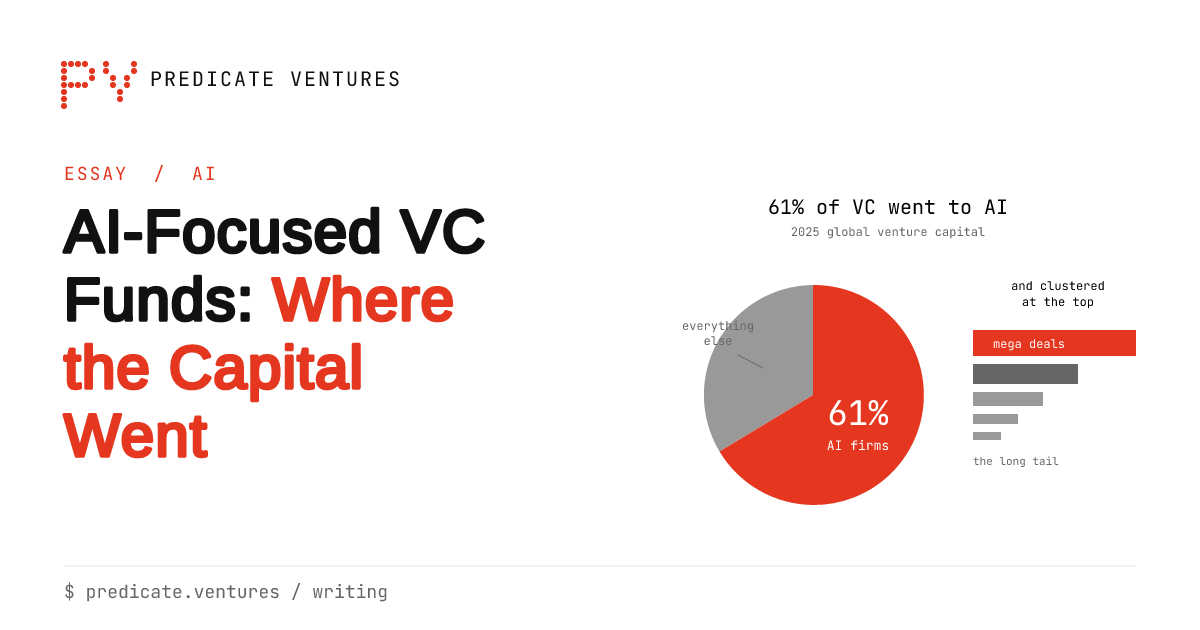
AI-focused funds now operate in a market where their category defines the whole. AI firms captured 61% of global venture capital in 2025, according to the OECD.
That figure reframes what an AI-focused strategy means. A fund that concentrates on AI is no longer taking a sector bet against the rest of venture. It is positioning inside the largest allocation flow in the asset class.
The scale is visible in the annual totals. Global VC investment in AI firms has climbed steadily, and PitchBook data through Q3 2025 put year-to-date AI funding at $192.7 billion.
Generative AI drives the totals
Much of the 2025 growth came from generative AI. The OECD's full report on AI venture investment attributes a large portion of the year's funding to generative AI firms specifically.
For an AI-focused fund, that concentration inside the category matters as much as the category's share of the whole. Capital is not spread evenly across machine learning applications, infrastructure, and tooling. It is weighted toward model developers and the companies building on top of them.
That weighting shapes where a fund can find entry points and where it will compete hardest for allocation.
The mega deal problem
The headline number hides a distribution problem. AI VC in 2025 concentrated heavily in mega deals over USD 100 million.
The top of the market is a small set of very large rounds. The OECD identifies the top five AI mega deals of 2025 as a meaningful slice of total deal value.
This creates two distinct games. One is access to the largest rounds, which is a capital and relationship contest that most funds cannot win. The other is early-stage sourcing, where a fund's edge comes from picking companies before the mega-round dynamics apply.
An AI-focused fund needs to know which game it is playing. A small fund that markets itself on AI exposure but has no path into the concentrated top of the market is selling access it does not have.
Deal size has moved
The average check has grown with the category. The OECD reports a significant increase in the mean AI VC deal size from 2014 to 2025.
Rising mean deal size compresses the returns math for funds that enter late. When rounds are larger, ownership at a given check size falls, and the entry valuation carries more of the risk. Funds that write early checks and hold through the growth of a company keep more of the outcome.
Geography is concentrated too
The capital is not only concentrated by deal size. It is concentrated by country. The United States accounted for the majority of AI VC deal value in 2025.
For an AI-focused fund, geographic concentration is both a constraint and a signal. Funds outside the US market face a smaller pool of the largest deals. Funds inside it face more competition for the same companies.
A fund's location and network determine which side of that concentration it sits on. A regional AI fund and a Bay Area AI fund are not running the same strategy even if their marketing language matches.
What this means for fund selection
For limited partners evaluating AI-focused funds, the market data suggests a few questions.
Where in the deal-size distribution does the fund operate? A fund claiming AI exposure through mega-round participation is buying into rounds that already carry high valuations. A fund sourcing early is taking a different risk with different ownership.
Is the fund's AI focus a thesis or a label? With AI at 61% of global venture, a generalist fund and an AI-focused fund may hold similar exposure by default. The label only adds value if it comes with sourcing, technical diligence, or portfolio support that a generalist lacks.
How does the fund handle the generative AI concentration? A strategy weighted entirely toward model developers competes for the same small set of companies as every large fund. A strategy that finds applications and infrastructure adjacent to those models has a wider field.
The risk inside the numbers
A category that takes 61% of venture capital carries concentration risk for the whole asset class. If AI valuations correct, the funds most exposed will be those that entered late and large, at the top of the deal-size curve.
The mega-deal structure amplifies this. When a small number of very large rounds define the market's deal value, a repricing of those companies moves the aggregate. Funds holding late-stage positions in the top rounds have the least protection.
Early-stage AI funds carry different risk. Their exposure is to company selection and survival rather than to entry valuation. That does not make them safe. It makes their risk legible in a way that late mega-round exposure is not.
Reading a fund against the market
The 2025 data gives LPs a backdrop to test any AI fund's pitch against.
A fund that describes AI as an emerging opportunity is describing a market that already commands most of venture capital. A fund that promises access to the largest AI companies should show the relationships that make that access real. A fund that claims an early-stage edge should show sourcing that operates below the mega-deal tier.
The category's dominance means the interesting question is no longer whether to invest in AI. It is which position in a concentrated, top-heavy market a given fund actually holds. That position, not the AI label, determines the return.