Building Agentic AI Systems: A Practical Guide
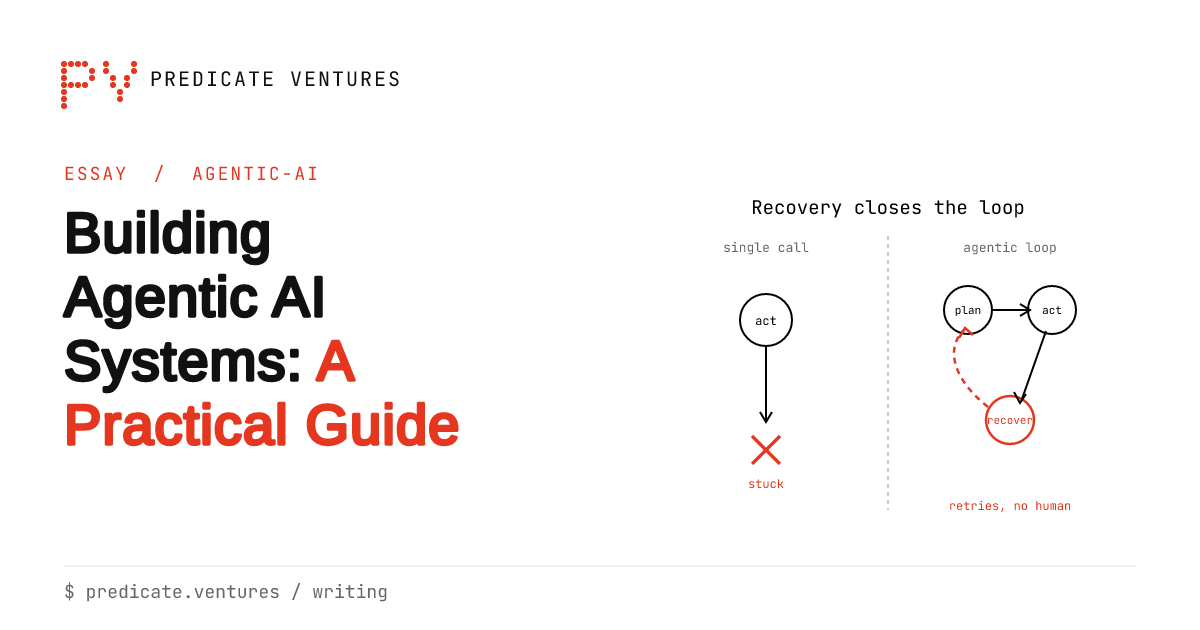
Agentic systems earn their keep when they can plan, act, and recover without a human in every loop.
Blake Aber · Predicate Ventures
What an agentic system actually is
An agentic AI system is software that pursues a goal across multiple steps, choosing its own actions along the way. It differs from a single model call in one respect: it decides what to do next based on what it observed last.
That feedback loop is the whole game. A model that answers a question is a function. An agent that reads a ticket, queries a database, drafts a fix, and verifies the result is a process.
Most production agents share four parts: a planner that breaks work into steps, tools that let the model act on the world, memory that carries state across steps, and a control layer that decides when to stop.
Start with the task, not the framework
The common failure is picking an agent framework before defining the task. Frameworks encode assumptions about how much autonomy the model gets, and those assumptions often fight your problem.
Begin by writing down the task boundary. What inputs arrive, what output counts as done, and what actions are allowed. A support agent that can issue refunds is a different risk profile than one that only reads knowledge base articles.
Then ask how many steps the task takes. Single-step tasks rarely need an agent at all. A prompt with the right context will outperform a loop that adds latency and failure modes.
Reserve agentic designs for work that genuinely branches: where the right second action depends on the first result, and you cannot enumerate the paths in advance.
Tools are the interface to the world
A model without tools can only produce text. Tools convert intent into effect: a search API, a database query, a code executor, a payment call.
Design tools the way you design any API. Give each one a narrow purpose, a clear name, and strict input validation. A tool named update_record that accepts arbitrary SQL is a liability. A tool named set_order_status that accepts an order ID and one of three states is safe.
Return structured results the model can reason about. When a tool fails, say why in plain language the model can act on. "Order not found" lets the agent try a different lookup; a stack trace does not.
Keep the tool count small. Every additional tool widens the space of wrong choices. Models select tools more reliably from a list of six than from a list of sixty.
Memory and state
Agents need to remember what they have done. Without memory, a loop repeats itself or forgets a partial result.
Separate two kinds of memory. Working memory holds the current task: the plan, the steps taken, the observations returned. It lives for the duration of one run. Long-term memory holds facts that persist across runs: user preferences, past resolutions, learned constraints.
Do not stuff everything into the context window. Context is expensive and models degrade when it fills with stale detail. Store the full history externally and feed the model a summarized, relevant slice.
Retrieval matters here. When an agent needs a fact from long-term memory, fetch it by relevance rather than pasting the entire store. The quality of what you retrieve sets a ceiling on the quality of what the agent decides.
The control loop
Every agent runs a loop: observe, decide, act, repeat. The control layer governs that loop, and it is where most reliability comes from.
Set a step budget. An agent that can loop forever will, usually on the day you least expect it. Cap the number of iterations and the total token spend per run.
Define stopping conditions explicitly. The agent stops when it produces a valid final output, when it exhausts its budget, or when it hits an error it cannot handle. Ambiguity in the stop condition produces agents that spin.
Add verification before the final answer commits. A second check — a validator model, a schema test, a rule engine — catches the confident mistakes that a single pass misses.
Handling failure
Agents fail in ways single calls do not. A tool times out. A step returns unexpected data. The model picks a valid action for an invalid reason.
Plan for each. Wrap tool calls in retries with backoff for transient errors. Give the model a path to report that it cannot complete the task, so it stops instead of fabricating a result.
Log every step: the input, the chosen action, the observation, the decision. When an agent behaves oddly, the trace tells you which step went wrong. Debugging an agent without traces is guessing.
Set guardrails at the boundary, not inside the prompt. A prompt instruction not to delete data is a suggestion. A permission check in the tool that refuses the delete is a control.
Multi-agent versus single-agent
The instinct to split work across many specialized agents is strong and often premature. Each agent boundary adds a handoff, and handoffs lose information.
Use a single agent with several tools until you have evidence it cannot cope. One planner reasoning over one task is easier to debug than a committee passing messages.
Move to multiple agents when responsibilities are genuinely separate and the interface between them is narrow. A researcher agent that returns findings to a writer agent works when the contract between them is a clean document, not a running conversation.
Shipping and measuring
An agent that works in a demo and an agent that works in production are different systems. The gap is edge cases, and edge cases only appear at volume.
Build an evaluation set before you scale. Collect real tasks, define what a correct outcome looks like, and score runs against it. Track completion rate, step count, and cost per task.
Roll out behind a human check first. Let the agent propose actions while a person approves them. The approval data becomes your evaluation set and your evidence for when to remove the human.
The measure of an agentic system is not how impressive its reasoning looks. It is whether it finishes the task, at acceptable cost, more often than the alternative. Design for that number and the rest follows.