Choosing a Due Diligence Solution That Holds Up
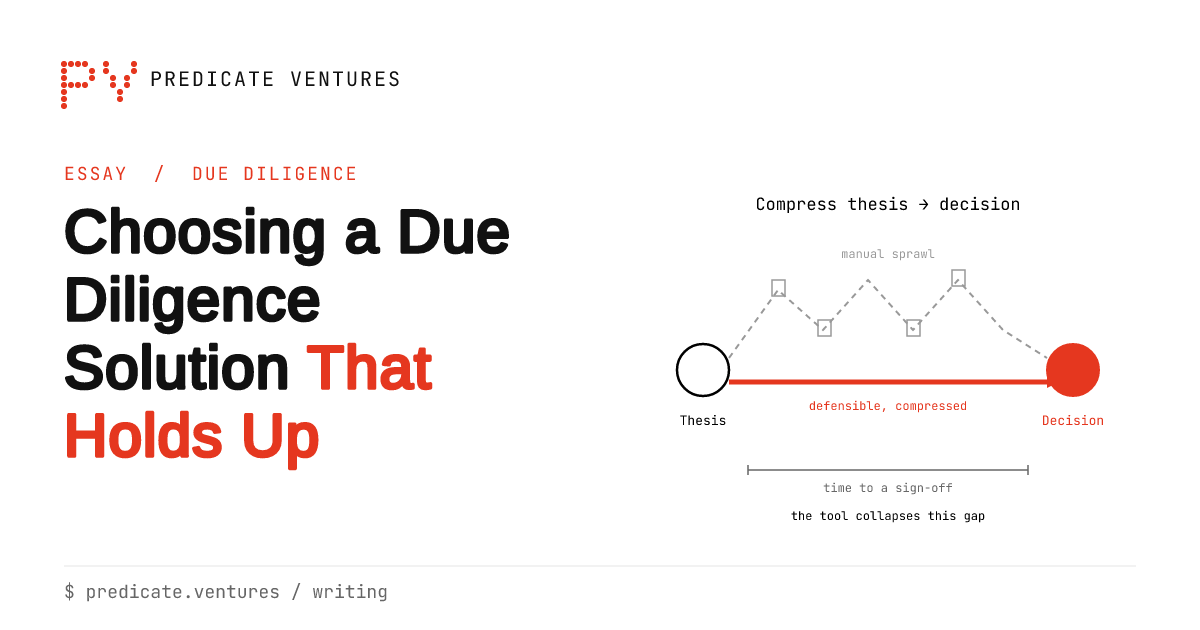
A due diligence solution should compress the time between a thesis and a defensible decision.
Blake Aber · Predicate Ventures
What a due diligence solution actually does
A due diligence solution is software that collects, organizes, and verifies the information a buyer or investor needs before committing capital. It sits between raw deal documents and the people who have to sign off on them.
The category covers a wide range. Some products focus on document management and the virtual data room. Others specialize in background screening, financial verification, or counterparty risk. A few attempt to cover the full workflow from intake to final memo.
The common goal is the same. Reduce the manual work of assembling evidence, and lower the chance that a material fact gets missed.
Why teams move off spreadsheets and shared drives
Many firms run diligence on a mix of email, spreadsheets, and a folder structure that grows by accident. This works at low volume. It breaks when deal count rises or when several people need to act on the same data at once.
The failure modes are predictable. Version control slips. A checklist lives in one analyst's head. Findings from one deal never inform the next because nothing is stored in a searchable form.
A dedicated solution addresses these problems by giving every deal a consistent structure. The checklist becomes a template. The findings become records. The audit trail becomes automatic.
That last point matters for regulated buyers. When an investment committee or a compliance reviewer asks who saw what and when, a system that logs activity answers the question without a manual reconstruction.
The core capabilities to evaluate
Feature lists from vendors tend to blur together. Focus on the functions that change how your team works.
Data room and document handling
The platform should ingest documents in bulk, keep them organized, and control who can see each file. Granular permissions matter when a seller wants to share financials with a select group while keeping sensitive contracts restricted.
Search quality separates good tools from filing cabinets. If you cannot find a clause across hundreds of PDFs in seconds, the data room is just storage.
Risk and verification screening
Many solutions connect to external sources for background checks, sanctions lists, litigation history, and corporate registries. The value here is breadth and freshness. A check against stale data gives false comfort.
Ask how often each source updates and which jurisdictions a vendor covers. A tool strong in one market may be thin in another.
Workflow and collaboration
Diligence is a team activity with handoffs. Look for assignment of tasks, status tracking, and a clear view of what remains open. The point is to see, at any moment, which items are blocking a decision.
Reporting and the final output
The end product is a memo or report that a decision maker reads. Solutions that generate structured summaries from the underlying records save days near the deadline, when time is shortest.
Where automated tools fall short
Automation handles volume and consistency. It does not replace judgment.
A screening tool can flag a director with prior litigation. It cannot tell you whether that case was frivolous or fatal. A document parser can extract a change-of-control clause. It cannot weigh that clause against your specific deal structure.
Treat any solution as a way to surface evidence faster, not as the decision itself. The risk is overconfidence. A clean automated report can lull a team into skipping the human review that catches the issues no model was trained to find.
Data quality sets the ceiling. A solution drawing on incomplete sources will produce confident answers from thin inputs. Verify the provenance before you trust the conclusion.
Matching the solution to your deal flow
The right choice depends on what you buy and how often.
A private equity firm running several deals a quarter needs strong workflow, repeatable templates, and a data room that scales. The cost of the platform is small against the cost of a missed clause in a nine-figure deal.
A venture investor doing earlier-stage work has different needs. The documents are fewer, but founder and market signals matter more. A lighter tool plus targeted background screening often serves better than a heavyweight enterprise suite.
Corporate development teams acquiring on an irregular schedule may not want an annual contract for software used twice a year. Per-deal pricing or a project-based engagement fits that pattern.
Vendor due diligence for ongoing supplier relationships is a separate use case. Here the priority is continuous monitoring rather than a one-time review. Some platforms specialize in this and re-screen counterparties on a schedule.
Questions to ask before you buy
Narrow the field with direct questions.
What data sources feed the risk checks, and how current are they? Vague answers here are a warning sign.
How does pricing scale with deal volume and users? Some contracts look cheap until a busy quarter pushes you past a tier.
What does onboarding require? A tool nobody adopts is worse than the spreadsheet it replaced. Ask about training and the time to first productive use.
How does the platform handle data security and retention? You are placing confidential deal information inside someone else's system. Encryption, access controls, and a clear deletion policy are baseline requirements.
Can it integrate with the systems you already run? A solution that exports cleanly to your CRM or document store reduces duplicate work.
A reasonable buying process
Start by mapping your current workflow and naming the specific points where it breaks. The gaps define your requirements, not the vendor's feature list.
Run a trial on a live or recent deal. A demo with sample data hides the friction you only feel on real documents. Watch how the team responds. Adoption predicts value more than any specification.
Measure the result against a simple standard. Did the solution shorten the cycle, reduce errors, or surface something the old process would have missed? If it does none of these, the cost is hard to justify.
The best due diligence solution is the one your team uses on every deal without being told to. Fit and adoption beat feature count. Choose for the work you actually do.