The Healthcare AI Bypass Pattern
How the AI programs that actually ship in healthcare avoid the 18-month enterprise blocker cycle. And when the bypass doesn't work.
Blake Aber · Predicate Ventures · 2026
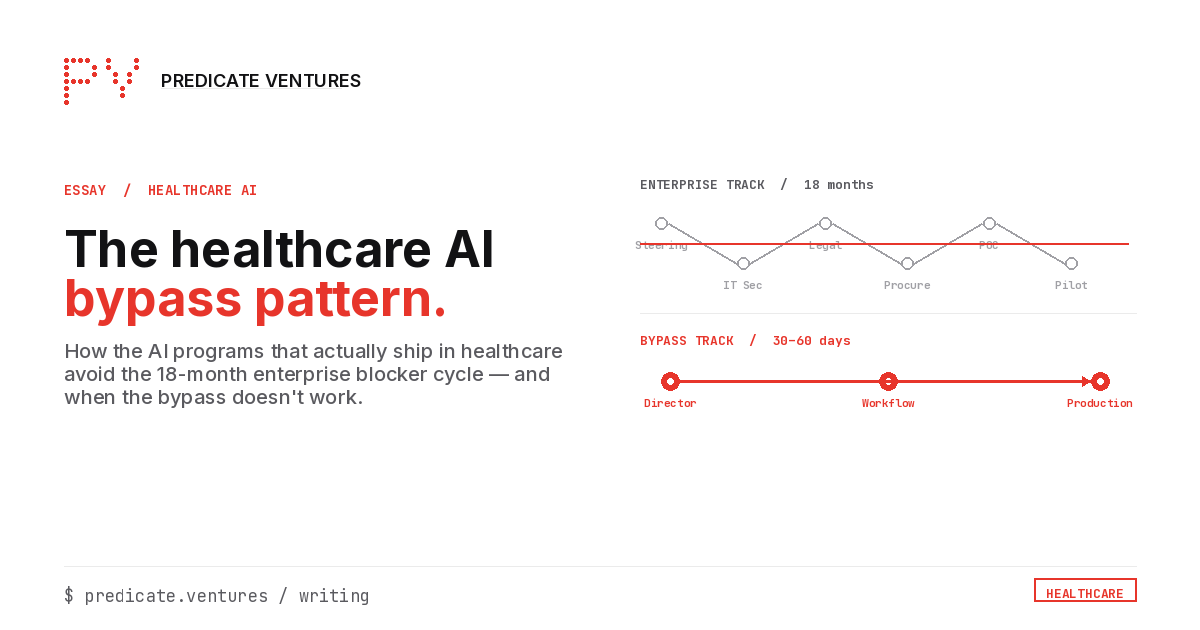
Most healthcare enterprise AI programs die in the same cycle. It goes like this.
A VP-level sponsor brings a promising AI use case to the steering committee. The committee approves a discovery phase. Discovery produces a requirements document that routes to IT security — six-to-eight-week queue. Security surfaces compliance questions that route to legal. Legal requires a formal vendor evaluation. Vendor evaluation runs three POCs. One survives. Procurement negotiates. A pilot finally runs in a controlled environment that doesn't match production. Results are mixed. Leadership asks for another evaluation. The AI program is two years old and has never touched a real workflow.
The programs that actually ship don't go through this cycle. They bypass it.
Why the bypass works
The bypass isn't a hack or a shortcut around governance. It's a structural difference in how the program is scoped from the beginning.
The programs that ship start inside a single department with a director-level sponsor who owns both the workflow AND the budget. That combination is the key. Not a VP with oversight responsibility. A director with operational authority over the specific process being changed. Not "enterprise-wide AI transformation." One department's one workflow.
Because the scope is contained to a single department, the program stays off the enterprise procurement track. The director's budget authority means there's no steering committee approval required. The AI is improving a process the director owns, not changing a cross-functional system that requires coordination.
This mirrors the case for winning with AI internally before pushing it outward: proof inside a process you own beats a theoretical mandate every time. Once production proof exists (once the AI is running on real workflows, with real outputs, and the efficiency gains are measurable), expansion becomes a management decision, not a procurement decision. The next department sees a working system and asks to replicate it. That's a very different conversation than asking a steering committee to approve a theoretical transformation.
Three conditions that make the bypass viable
Single department scope. The workflow begins and ends inside one functional area. No cross-functional handoffs that require other teams to change their processes. If the workflow crosses organizational lines, the bypass doesn't work. You need the committee.
Director-level sponsor with P&L or cost-center authority. "Champion" is not enough. The sponsor must be able to approve expenditure, change the workflow, and accept the output without escalating. If every decision requires sign-off from above, the program is already on the committee track.
Administrative or operational workflow. The bypass is most viable for workflows that are clearly administrative: prior authorization workflows, documentation workflows, scheduling coordination, intake routing, billing reconciliation. Not clinical-decision-support, not patient-facing AI, not anything that could be classified as a regulated medical device. Those workflows demand eval, audit, and rollback treated as design inputs from the first day, which is a different program entirely.
Two conditions where the bypass fails
Compliance-only workflows. If the workflow is itself a regulatory submission or a compliance artifact (a filing, an attestation, an audit report), the regulatory sign-off is the procurement track. There's no way around it. These workflows require the committee because the committee is the control structure the regulator expects to see.
Clinical-decision-support FDA path. If the AI tool could be classified as a Software as a Medical Device (SaMD), and it's influencing a clinical decision, triaging patients, or producing a clinical recommendation, the FDA's 510(k) or De Novo pathway applies. The bypass doesn't work here. The regulatory pathway is the path, and there are no shortcuts.
Walking the bypass
The AI itself is usually not the bottleneck. The bottleneck is getting a department director to scope the problem narrowly enough to stay off the enterprise procurement track. Then shipping something narrow enough to produce real results in 30-60 days.
That requires change management more than AI expertise. Which workflows can be scoped to a single department, which output types survive a compliance review, how to structure a 30-day engagement that produces verifiable results: that's the work.