Multi Agent Orchestration in Production
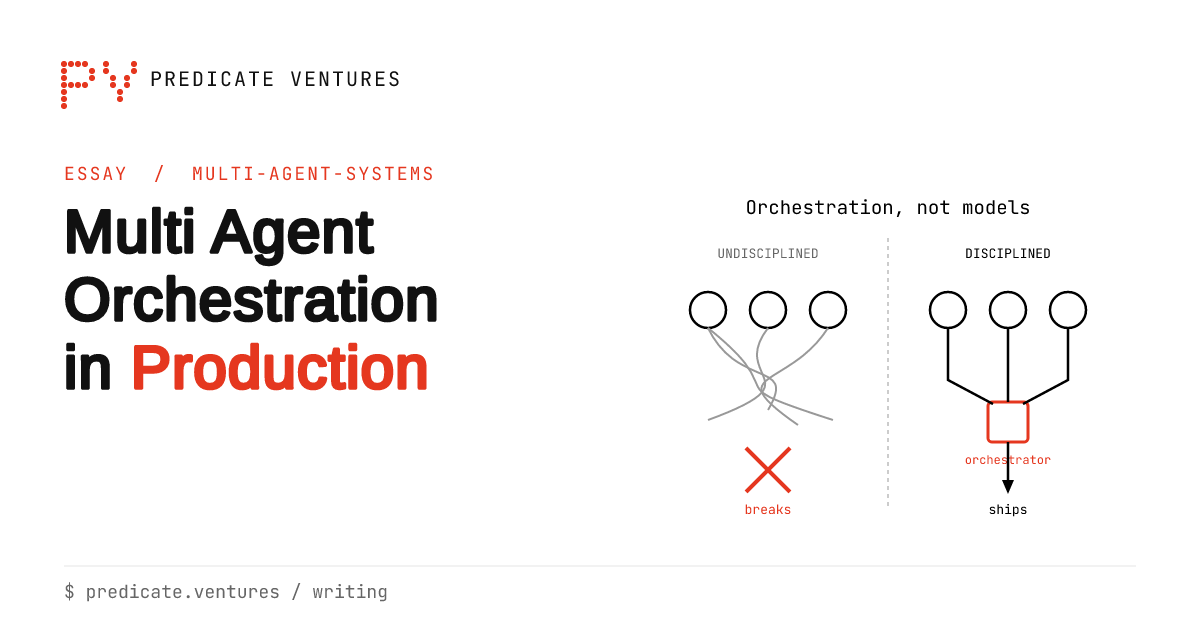
Most multi agent systems fail not because the models are weak, but because the orchestration around them is undisciplined.
Blake Aber · Predicate Ventures
Multi agent orchestration is the practice of coordinating several specialized agents to complete work that a single prompt cannot. The demos look clean. The production systems rarely do.
This article covers what actually matters once agents leave the notebook: how to structure coordination, how to measure whether it works, how to contain damage, and where the costs and failures hide.
What orchestration actually means
An agent is a model plus tools plus a loop. Orchestration is the layer that decides which agents run, in what order, with what context, and when to stop.
The mistake is treating orchestration as prompt arrangement. It is control flow. The same engineering rigor you apply to distributed systems applies here, because that is what you are building.
Three structures cover most real work.
Supervisor-worker
A supervisor agent receives the task, decomposes it, and routes subtasks to workers. Workers return results; the supervisor composes the final answer.
This is the default for good reason. Routing logic lives in one place, so you can inspect and constrain it. The failure mode is a supervisor that hallucinates subtasks or loops on the same decomposition.
Pipeline
Agents run in a fixed sequence, each consuming the prior output. A research agent feeds a drafting agent feeds a review agent.
Pipelines are predictable and cheap to reason about. They break when a stage silently degrades and downstream agents treat garbage as signal. Validation between stages is not optional.
Blackboard
Agents read and write to shared state, acting when they see something they can advance. This suits open-ended problems with no clear task order.
It is also the hardest to debug. Shared mutable state across autonomous actors produces race conditions and nondeterminism that are painful to reproduce.
Start with supervisor-worker or pipeline. Reach for blackboard only when the problem genuinely resists sequencing.
Context is the real bottleneck
Agents coordinate through context. The question is how much each agent sees and how that context is assembled.
Two patterns dominate.
Full context sharing passes the entire history to every agent. It preserves information but inflates token cost and introduces noise. By the fifth hop, an agent is reading four irrelevant conversations.
Scoped context gives each agent only what its task requires. This is cheaper and more accurate, but it demands that the orchestrator know what each agent needs. That knowledge is itself engineering work.
Most reliable systems use scoped context with explicit handoffs. The orchestrator writes a clean task specification for each agent rather than forwarding a growing transcript.
Treat the handoff as an API contract. Define what goes in, what comes out, and what the receiver is allowed to assume.
Evaluation before scale
You cannot improve what you cannot measure, and multi agent systems resist measurement because failure is distributed. The final answer is wrong, but which agent caused it?
Build evaluation at two levels.
Component evaluation
Test each agent in isolation against fixed inputs. The research agent gets a query; you check its output against known-good results. This isolates capability from coordination.
Component tests are fast and cheap, and they catch regressions when you swap a model or edit a prompt.
Trajectory evaluation
Test the full run. Did the system reach the right outcome, and did it get there by a reasonable path? A system that produces the right answer through ten wasted agent calls is still broken.
Trajectory evaluation requires logging every agent decision, tool call, and handoff. Instrument this from day one. Retrofitting observability into an agent system is expensive and incomplete.
Score trajectories on outcome, path efficiency, and cost. All three move together in a healthy system.
Guardrails that hold
Autonomous agents acting through tools can do real damage. A pipeline that writes to production, sends messages, or spends money needs limits that do not depend on the model behaving.
Put guardrails outside the agent.
Tool-level constraints bound what any agent can do regardless of what it decides. An agent with database access gets read-only credentials unless a write is explicitly authorized. The permission lives in infrastructure, not in a prompt instruction.
Step and budget limits cap how many actions a run can take and how much it can spend. An agent stuck in a loop hits the ceiling and stops instead of running until someone notices the bill.
Human checkpoints gate irreversible actions. The agent proposes; a person approves. Place these at the small number of points where a mistake is costly and hard to undo.
Guardrails written as prompt instructions are suggestions. Guardrails written as code are constraints.
Cost is an architecture decision
Multi agent systems multiply token usage. A supervisor coordinating five workers across three rounds can issue dozens of model calls for one user request. The cost is not linear in the task; it is a function of the orchestration shape.
Three levers control it.
Match model size to task. Use a small model for routing and extraction, a large one only where reasoning depth earns its price. Running every agent on the largest model is the most common source of waste.
Cache aggressively. Repeated context across agents and runs is a candidate for prompt caching. The savings compound in systems that reuse system prompts and tool definitions.
Cut unnecessary hops. Every additional agent is additional cost and additional failure surface. If two agents can be one without losing clarity, make them one.
Failure modes to design against
Some failures recur across nearly every multi agent system.
Cascading errors, where one agent's mistake becomes the next agent's premise. Validation between stages contains this.
Infinite loops, where agents hand work back and forth without progress. Step limits and loop detection stop it.
Context drift, where the accumulated history pulls agents away from the original goal. Scoped context and explicit task specs reduce it.
Confident wrongness, where a failed agent returns a plausible answer instead of signaling failure. Require agents to report confidence and to fail loudly when they cannot complete a task.
The discipline is the same in every case: assume each agent will fail, and build the orchestration so that failure is detected, contained, and recoverable.
The shape of a working system
A multi agent system that survives production tends to look modest. Few agents, clear roles, scoped context, constraints in code, and instrumentation on every decision.
The impressive demos add agents. The durable systems remove them. Orchestration quality, not agent count, decides whether the thing works.