Why VC Firms Invest in AI Startups Now
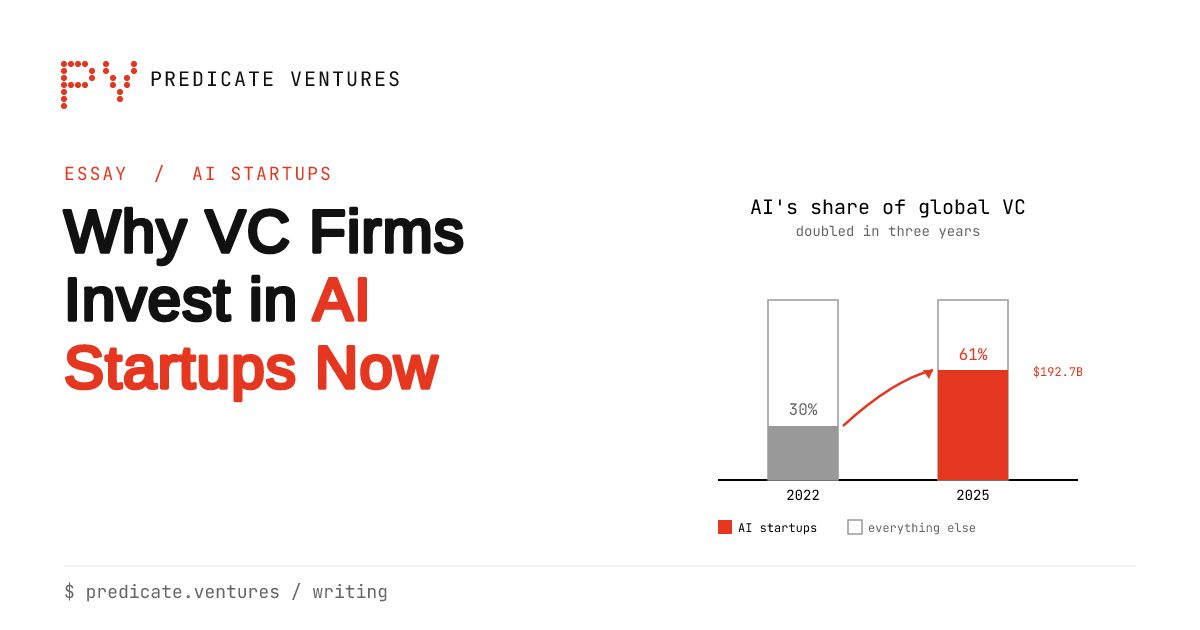
The share of venture dollars going to AI has doubled in three years, and the concentration is now impossible to ignore.
Blake Aber · Predicate Ventures · 2026
The scale of the shift
AI firms made up 61% of all global VC investment in 2025, up from 30% in 2022, per the OECD. That is a doubling of share in three years.
The dollar figures match the percentages. VCs put $192.7 billion into AI startups in 2025 through Q3, according to PitchBook data reported by Bloomberg. That pace put 2025 on track to be the first year where more than half of all VC dollars went to AI.
When a single category crosses half of an entire asset class, it stops being a theme and becomes the market itself.
Why VC firms are concentrating on AI
Three forces explain the concentration.
The first is model performance. Capabilities that were research demos in 2022 became shippable products by 2025. Investors fund what customers will pay for, and paying customers arrived.
The second is defensibility questions. Firms are trying to identify which AI startups own something durable versus which are thin wrappers on someone else's model. That question sends money toward companies with data advantages, distribution, or infrastructure ownership.
The third is fund math. When one category compounds faster than the rest of a portfolio, partners feel pressure to keep pace. A fund that skips AI risks underperforming its peers on paper, even before returns are realized.
Where the money actually goes
The headline share hides an uneven distribution.
AI firms working on IT infrastructure and hosting attracted the most VC investment, reaching $109.3 billion in 2025, per the OECD. That single infrastructure layer accounts for $109.3 billion, more than half of the $192.7 billion figure.
The pattern tells you something about how VC firms invest in AI startups. The largest checks flow to the companies building the compute, hosting, and foundational systems that everything else runs on. Application-layer startups compete for the remainder.
For founders, this means the fundraising experience differs sharply by layer. Infrastructure companies raise large rounds against large capital needs. Application companies raise against traction and margins.
How to read the concentration as an investor
A market where one category takes 61% of dollars carries two readings, and both are worth holding at once.
The optimistic reading: AI is a general-purpose capability, and capital is repricing entire industries around it. Under this view, the concentration reflects genuine opportunity rather than crowding.
The cautious reading: capital concentration this fast tends to compress returns. When most funds chase the same category, entry valuations rise and future multiples fall. The winners may be real while the average outcome disappoints.
Neither reading requires predicting a crash. Both suggest discipline on price and a clear thesis about which layer of the stack a given check belongs in.
Questions that separate the checks
Before committing to an AI startup, a firm should be able to answer a few things plainly.
What does this company own that a model provider could not replicate? Data, distribution, workflow lock-in, or regulatory position are the usual candidates.
What is the gross margin after inference costs? Some AI products carry compute costs that erode the margins investors expect from software.
Which layer is this, and does the check size match the layer? Infrastructure and application companies have different capital profiles, and mismatches show up later as down rounds.
What this means for founders raising now
The environment is generous to AI founders in one sense and demanding in another.
Capital is available. With more than half of VC dollars aimed at AI, a credible AI startup has more funding options than a comparable non-AI company.
But availability raises the bar. When many companies pitch similar capabilities, investors filter harder on defensibility and unit economics. A founder who cannot articulate what stays proprietary as models improve will struggle, regardless of how much capital is in the market.
The practical move is to raise against a specific advantage rather than against the category. "We do AI" is no longer a differentiator when 61% of the market does too.
The durability question
The honest uncertainty is how long this share persists.
A doubling from 30% to 61% in three years is not a trend that can continue at the same rate, because the ceiling is 100%. At some point the share stabilizes or reverts.
What happens next depends on returns. If early AI investments return capital at rates that justify the concentration, allocators keep the weighting. If they do not, capital rotates and the share falls.
The OECD and PitchBook figures describe where money went, not where it will earn. That distinction matters. Investment share is a measure of conviction, and conviction is priced before it is proven.
The takeaway
VC firms invest in AI startups at a level without precedent in the asset class. The $192.7 billion figure and the 61% share both point to the same fact: AI is now the center of gravity for venture capital, not a segment of it.
The useful response is neither enthusiasm nor skepticism but specificity. Know which layer a company sits in. Know what it owns. Know whether the check size fits the capital profile.
The firms that do well in this cycle will be the ones that treated a 61% market share as a reason for discipline rather than a reason to relax it.