AI Strategy and Implementation That Works
The gap between AI interest and AI results is rarely about model quality. It is about execution.
Blake Aber · Predicate Ventures · 2026
Most companies do not have an AI problem. They have an execution problem.
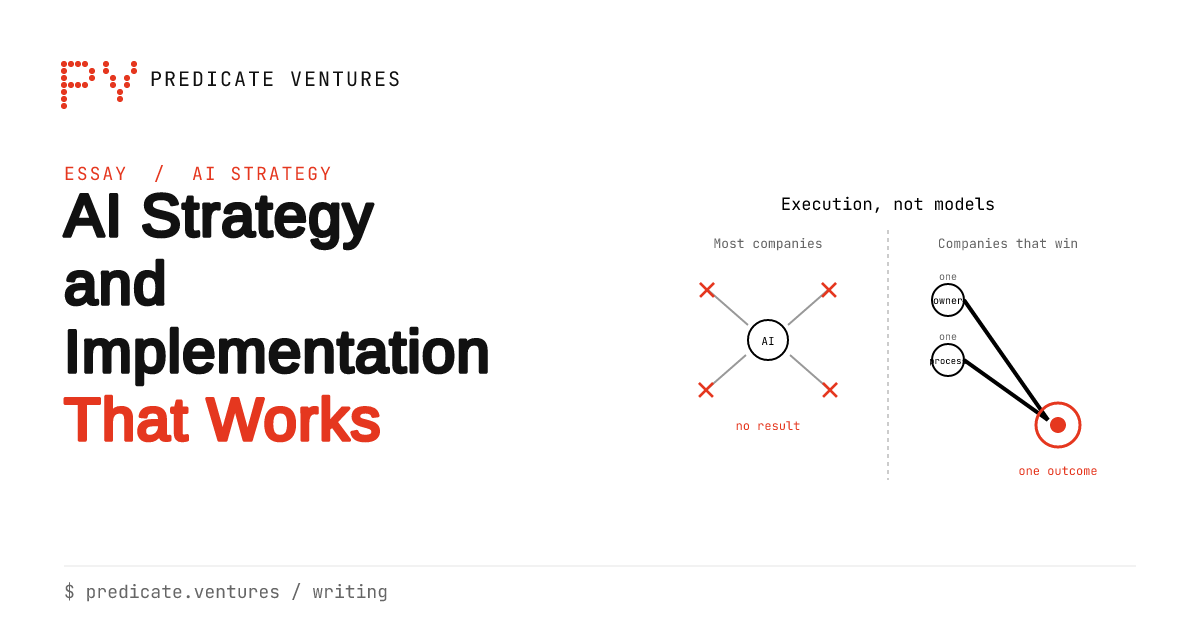
The distance between interest and results is usually not model quality or tooling. It is the absence of a clear plan tied to one business outcome, one owner, and one operating process that can actually change.
That distinction matters whether you run a startup, a professional services firm, or a mid-market company under real delivery pressure. Leaders do not need another workshop on what AI could do someday. They need a disciplined way to decide where it belongs, how it gets deployed, who owns it, and what financial improvement it is expected to produce.
What AI strategy and implementation actually means
Strategy is the decision layer. It defines where AI fits in the business, which workflows matter most, what success looks like, and what risks are acceptable.
Implementation is the delivery layer. It turns that strategy into working systems, operating rules, integrations, and measurable process changes.
Many firms separate these two steps too aggressively. That is where momentum dies. Strategy without implementation becomes slideware. Implementation without strategy creates scattered pilots that never reach daily operations.
The right approach connects both from the start, so every recommendation is judged by whether it can be deployed, adopted, governed, and measured.
For most leadership teams, this is less about buying a platform and more about redesigning a process. If the workflow is unclear, the approvals are inconsistent, or the data is unreliable, AI amplifies confusion rather than removing it.
Start with operating pain, not AI use cases
The fastest way to waste budget is to ask, "Where can we use AI?" That question sounds reasonable, but it produces a long list of disconnected ideas.
A better question is, "Where is the business losing time, margin, consistency, or client confidence?" That shift changes the conversation immediately.
A law firm may not need a dozen AI pilots. It may need faster intake, cleaner matter summaries, and better internal knowledge retrieval. A services business may not need generative AI across every team. It may need faster proposal drafting, stronger CRM hygiene, and fewer manual handoffs between sales and delivery.
Start with operational friction that already has a cost. If you can quantify the current pain, you can prioritize implementation rationally. If you cannot quantify it, you are probably still in the idea stage.
The best priorities are narrow
Executives often assume the first AI initiative should be broad and transformative. In practice, the best first move is usually narrower than expected.
It should affect a real workflow, touch a manageable set of users, and produce a visible business result in weeks, not quarters. That might mean reducing client intake time by 60 percent, cutting internal research time in half, or improving support response quality without adding headcount.
These are useful starting points because they are operationally specific. They have a baseline, a process owner, and a path to adoption.
Broad ambitions are still valid. But they come after the business proves it can move from concept to production. AI maturity is earned through repeatable execution, not announced through strategy decks.
What good implementation looks like
A credible implementation has four parts working together.
Define the workflow
Understand how work moves today, where decisions happen, what inputs are needed, and where errors or delays occur. Without this map, teams automate isolated tasks while leaving the real bottleneck intact.
Match technical design to risk
Some use cases run on lightweight tools and standard APIs. Others need stronger controls, human review, audit trails, or private infrastructure. There is no prize for overengineering, but underengineering client-facing or regulated workflows creates expensive problems later.
Assign ownership of adoption
This is often missed. A technically sound solution still fails if nobody is accountable for rollout, training, exception handling, and process enforcement. AI changes work. If leadership does not manage that change directly, usage becomes inconsistent and the business never captures full value.
Measure against operating metrics
Time saved is useful, but margin impact, cycle time reduction, utilization improvement, conversion lift, and service quality are better indicators of whether implementation is worth expanding. Vague satisfaction scores are not.
Why pilots fail
Most failed pilots are not technology failures. They fail because the business treated the pilot as a demo rather than a controlled operating experiment.
A demo proves a model can generate output. A pilot proves a business can use that output inside a real process with acceptable quality, speed, and oversight. Those are very different standards.
Pilots usually stall for one of three reasons. The first is poor problem selection: teams choose something flashy instead of something operationally valuable. The second is weak governance: nobody decides where human review is required, what data can be used, or how performance gets monitored. The third is the lack of an implementation path: even when the pilot works, there is no plan for integration, ownership, or process change.
This is why serious firms treat pilots as production rehearsals. The point is not to impress stakeholders. It is to generate enough evidence to make a deployment decision with confidence.
Different companies need different operating models
A startup does not need the same model as a 200-person services company. Company stage matters because decision speed, process maturity, and internal technical capacity all change the shape of the work.
A startup often needs fractional senior guidance more than a large program. The focus is usually product direction, investor-ready technical clarity, lean internal automation, and early governance choices that will not create debt later. Speed matters, but so does architectural discipline.
A firm with 5 to 50 employees usually benefits from workflow-level automation and practical systems design. Intake, proposals, documentation, scheduling, reporting, and knowledge retrieval often produce immediate returns. Leadership in these firms wants fast implementation and clear savings, because every recovered hour affects capacity and client service.
A mid-market organization with 50 to 500 employees needs tighter coordination across functions. The challenge is less about finding use cases and more about sequencing them, standardizing governance, and avoiding fragmented tools across departments. Here, AI should be treated as an operating capability, not a series of isolated experiments.
Governance is not optional overhead
Many executives hear "governance" and assume bureaucracy. That is usually a mistake. In AI deployments, governance is what allows a company to move faster without creating preventable risk.
Good governance answers practical questions. What data can be used? When is a human required to review output? Which systems are approved? How are prompts, agents, and automations versioned? What happens when output quality drops or a workflow changes upstream?
The right level depends on the use case. Internal drafting support does not need the same controls as client-facing decision support. But every company needs a minimum operating standard. Without one, teams improvise, and improvisation becomes hidden risk.
This is one reason firms like Predicate Ventures focus on systematic adoption instead of one-off experimentation. The goal is not just to ship something quickly. It is to ship something the business can trust, extend, and govern over time.
How to evaluate whether AI is working
The cleanest test is whether the business runs better after deployment. That sounds obvious, but many teams still evaluate AI on novelty instead of operational effect.
A useful scorecard includes speed, quality, adoption, and financial impact. Did cycle times improve? Did output quality hold or improve? Are teams actually using the system in the intended workflow? Did the business reduce manual effort, expand capacity, improve conversion, or protect margin?
There is also a trade-off to watch. Some AI systems save time but increase review burden. Others improve consistency but reduce flexibility for edge cases. That does not make them bad investments. It means implementation needs refinement. Mature teams expect these trade-offs and adjust the operating design rather than declaring success too early.
The companies that win are usually the most disciplined
The market still rewards speed, but speed without structure creates rework. The companies getting real returns from AI are usually not the loudest adopters. They are the ones making sober decisions about process, ownership, controls, and metrics.
They pick a small number of high-value workflows. They assign executive ownership. They build with production in mind. They measure outcomes that finance and operations both respect. Then they expand from evidence, not enthusiasm.
That is the real advantage of strong AI strategy and implementation. It turns AI from a talking point into an operating capability. When a business does that consistently, the upside is not theoretical. It shows up in cleaner execution, faster teams, better client experience, and margins that improve for reasons you can actually explain.