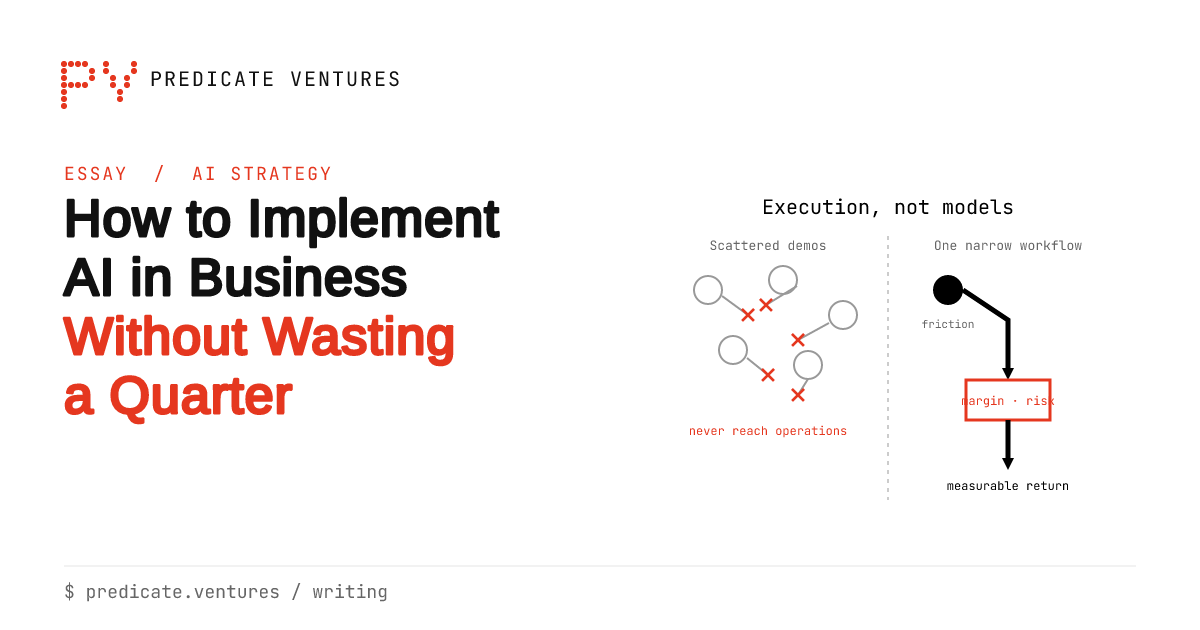
How to Implement AI in Business Without Wasting a Quarter
Most companies do not have an AI problem. They have an execution problem.
Blake Aber · Predicate Ventures · 2026
That distinction matters when you decide how to put AI into a business. The market is full of demos, vendor promises, and one-off experiments that never reach daily operations.
What moves the needle is not access to more tools. It is a disciplined plan that ties AI to margin, throughput, client experience, and risk control.
The right question is not "Where can we use AI?" It is "Where can AI remove friction, improve decision quality, or increase output without adding operational chaos?" That is where implementation starts to stick.
Implement Through Priorities, Not Model Debates
AI should enter a business the way any meaningful operational initiative does: through business priorities, process analysis, and accountability.
If the work starts with a model selection debate or a broad innovation mandate, it usually drifts. If it starts with a specific workflow tied to cost, speed, revenue, or quality, it has a much better chance of producing a real return.
The first step is choosing a narrow business problem with visible economics. Good candidates sit in repetitive, delay-prone, or judgment-heavy processes.
Client intake, sales qualification, proposal generation, support triage, internal knowledge retrieval, document review, scheduling, and reporting are common examples. They are not glamorous, but they affect labor cost, turnaround time, and customer responsiveness.
Not every process fits. If a workflow is poorly defined, changes every week, or depends on tacit judgment no one has documented, automation may expose the mess rather than solve it. In those cases, light process design has to happen first.
Start With Business Value, Not Features
Executives often get pulled into conversations about model quality, copilots, agents, or platform comparisons. Those details matter later. At the start they distract from the bigger question: what result are you buying?
Identify one metric that should improve if the implementation works. Reduced time to first response. Fewer hours spent on manual review. More proposals per employee. Lower churn in support. Faster close cycles.
If there is no clear metric, the initiative is still too vague.
This is also where trade-offs surface. Some use cases are easy to deploy but produce modest gains. Others carry larger upside but require integration work, policy controls, and stronger change management.
A firm improving internal meeting notes can move quickly. A healthcare-adjacent company automating intake recommendations needs much more oversight. Speed matters, but not more than business fit and risk profile.
Assess Your Data and Process Reality
AI systems are only as useful as the inputs, workflows, and decisions around them. You do not need perfect data before starting. You do need a realistic view of what the system will read, generate, classify, or recommend.
Look at three things.
Where the information lives
If the use case depends on data spread across inboxes, PDFs, CRMs, shared drives, and team chat, implementation is possible, but orchestration becomes part of the project.
Whether the process is consistent
If five employees handle the same task five different ways, define the target workflow before layering in AI.
What accuracy is actually required
Some internal draft-generation tasks tolerate occasional errors when a human reviews the output. Client-facing or regulated workflows need stricter guardrails.
Many businesses either overestimate readiness or become too cautious. You do not need enterprise-grade data infrastructure to begin. You do need enough process clarity to know what the system should do, when a human should intervene, and how success will be measured.
Build a Pilot That Survives Contact With Operations
A pilot should be small enough to launch quickly and serious enough to test real operating conditions. That usually means one workflow, one team, one owner, and one decision path.
A professional services firm might deploy AI to draft follow-up emails and summarize discovery calls for business development. A startup might categorize inbound support and recommend responses. A mid-market operations team might automate invoice exception review or internal knowledge retrieval for frontline staff.
Each pilot is narrow, measurable, and tied to existing work. The goal is not to prove AI is interesting. The goal is to prove the business can use it repeatedly, safely, and consistently enough to justify broader deployment.
That shapes the design. A pilot needs a clear owner, baseline metrics, usage expectations, escalation rules, and a review cadence.
If no one owns adoption after the demo, the project stalls. If no one tracks impact, it becomes a belief system instead of an operating improvement.
Treat Governance as Part of Implementation
Governance cannot be deferred until after the tools are already in use. By then, informal adoption has usually spread faster than policy.
At a minimum, a business needs clarity on what data can be used, which systems are approved, when human review is required, and how outputs are monitored.
The right level depends on company size, customer expectations, and regulatory exposure. A 15-person firm does not need the same control structure as a 300-person organization handling sensitive financial or customer records. Both need basic operating rules.
This is where initiatives become too loose or too heavy. Too loose, and you create security, compliance, and quality risk. Too heavy, and the team avoids the tools entirely. Good governance makes deployment safer and faster, not buried in approval cycles.
Choose an Implementation Path That Fits Your Size
Business size affects AI implementation more than most vendors admit.
Startups usually benefit from focused advisory and technical direction rather than broad platform rollouts. They need speed, a sensible architecture, and enough governance to avoid building fragile systems they will have to replace. Often that means lightweight internal automation paired with a product strategy lens, especially if the company plans to present AI capability to investors or customers.
Smaller firms with 5 to 50 employees get the best results from workflow automation tied to client delivery and back-office throughput. They rarely need a large transformation program. They need a few high-impact systems that reduce administrative drag and let a lean team operate at a higher level.
Mid-market companies need more structure. The challenge is not just identifying use cases. It is aligning stakeholders, integrating with existing systems, managing access controls, and building a repeatable operating model. Assessment, pilot design, and deployment governance matter more than tool experimentation.
Measure Outcomes That Finance Will Respect
Many AI projects look promising in a demo and weak in a budget review because the measurement model is sloppy. Saying a team "saved time" is not enough.
The business needs to know whether savings changed throughput, reduced staffing pressure, improved retention, increased capacity, or lowered error rates.
Define value in operating terms. If AI cuts proposal drafting from three hours to 45 minutes, what happened next? Did the firm send more proposals, respond faster, or improve win rate? If support triage became faster, did response times improve enough to affect satisfaction or renewal risk?
Those second-order effects are where the real return sits.
This is why systematic adoption outperforms ad hoc tool usage. When implementation connects to process owners and operating metrics, you can decide whether to expand, refine, or stop. That discipline matters more than enthusiasm.
Expect Change Management to Be Part of the Job
AI implementation is not purely technical. It changes how people work, what they trust, and where decisions get made. Some employees over-rely on it. Others ignore it. Both responses are normal.
The fix is not motivational messaging. It is operational clarity. Teams need to know what the tool is for, where it helps, what good usage looks like, and where human judgment still applies.
Training should be tied to actual workflows, not abstract AI education. When people see the system reduce repetitive work without lowering quality, adoption gets easier.
This is where an execution-first partner is useful. Firms like Predicate Ventures focus on moving from assessment to deployment with business controls intact, which is often the missing piece for companies that know AI matters but lack the internal bandwidth to architect it correctly.
The companies that get value from AI are rarely the ones making the loudest announcements. They treat implementation as an operating decision, not a branding exercise. Start with one workflow that matters, put guardrails around it, measure the result, and expand from there. That is usually how real progress begins.