How Accurate Are AI Image Detectors?
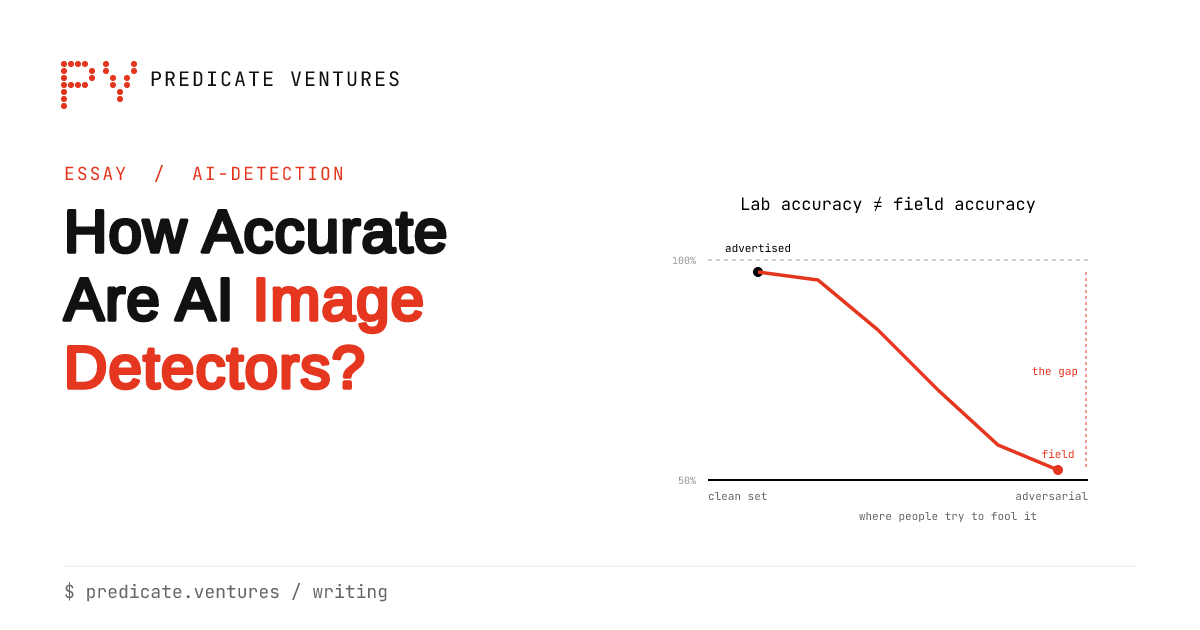
AI image detectors report high accuracy in the lab and lower accuracy everywhere people actually try to fool them.
Blake Aber · Predicate Ventures
The headline number is the wrong number
Vendors advertise detection accuracy in the high 90s. Those figures come from clean test sets: a batch of known generated images, a batch of known real ones, scored under conditions that resemble the training data.
That number tells you how a detector performs against images it already understands. It says little about the images you will receive once a product ships and people have a reason to beat it.
Accuracy is not one value. It is a distribution that shifts with the generator, the post-processing, the compression, and the intent of the person uploading the file.
Why accuracy drops outside the lab
Most detectors learn statistical traces left by specific generation methods. A model trained on one family of diffusion outputs learns the fingerprints of that family. Show it images from a generator released after its training cutoff and performance falls.
This is the core limitation. Detection is a classification problem anchored to the past, while image generation moves forward every month. A detector is always chasing the generators it has seen.
Three common degradations:
- New generators. Each release changes the artifacts a detector relies on. Accuracy against unseen models can drop well below the advertised figure.
- Post-processing. Screenshotting, resizing, re-saving as JPEG, and social-platform recompression strip or distort the signals detectors read.
- Mixed content. Partial edits, inpainted regions, and AI elements composited into real photos sit between the two classes a binary detector expects.
None of these are edge cases. They describe the normal lifecycle of an image that travels through a marketplace or social feed.
The adversarial problem
Trust and safety is adversarial by definition. The people you most want to catch are the ones actively studying your detector.
Fraud rings, review farms, and listing scammers treat detection as an obstacle to route around. They test uploads against public detectors, apply the perturbations that lower confidence, and keep the variants that pass.
A detector evaluated on cooperative data will overstate its real accuracy by a wide margin, because the attacker population behaves nothing like the test set. Benign users upload raw files. Bad actors upload files engineered to defeat you.
This gap is where product harm lives. The failure mode that matters is not random error. It is the structured error an adversary can produce on demand.
Two kinds of wrong, two kinds of cost
Every detector trades false positives against false negatives, and the costs are not symmetric.
A false positive flags a real image as generated. In a marketplace that means penalizing a legitimate seller, removing a genuine listing, or accusing a real user of fraud. The cost is trust, appeals, and churn.
A false negative lets a generated image pass as real. The cost is a fake listing, a synthetic identity, or a fraudulent review that reaches customers.
A single accuracy percentage hides this trade-off. You cannot tune a system you measure with one number. You need the full confusion matrix at the thresholds you intend to deploy, segmented by the content types you actually see.
Evaluation that holds up at marketplace scale
Validating detection before users find the failures means building evaluation that resembles production, not the vendor's demo.
Test on content you did not train on
Hold out entire generator families, not random samples. The question is how the detector handles images unlike anything in its training data, because that is what next quarter looks like.
Include the pipeline, not just the pixels
Run the images through the same compression, resizing, and format changes your platform applies. A detector that scores well on original files and poorly on platform-processed files will fail where it counts.
Build an adversarial set on purpose
Task a small team with defeating the detector using public tools and simple perturbations. Measure accuracy on that set separately. The delta between clean and adversarial accuracy is the number that predicts real-world performance.
Segment, then report
Aggregate accuracy averages away the failures. Break results down by content category, image source, and user segment. The weak slice is where abuse concentrates, and it is invisible in the headline figure.
Monitor drift after launch
Accuracy decays as generators advance. Sample production uploads, label them, and track detection rate over time. A detector that passed acceptance six months ago may now be guessing on the newest outputs.
Detection as one signal, not the verdict
Treating a detector score as a binary verdict concentrates all the risk in a single fragile model. A score above a threshold triggers removal; a score below it grants a pass. Both decisions inherit every weakness above.
Stronger systems treat detection as one input among several. Account history, upload patterns, device and network signals, and the economic context of an action carry information a pixel-level model never sees.
A generated product photo from an established seller with years of clean history means something different from the same image uploaded by a day-old account. The detector cannot tell you that. The surrounding signals can.
This also reshapes the cost of error. When detection feeds a risk score rather than a kill switch, a false positive routes to review instead of punishing a real user outright, and a false negative still faces other checks downstream.
What to ask before you trust a number
When a detector reports its accuracy, work backward to the conditions behind it.
- Which generators were in the test set, and which were held out?
- Were the images processed through a realistic platform pipeline, or scored raw?
- Was any adversarial manipulation applied, or did the test assume cooperative uploads?
- At what threshold, and what is the false-positive rate at that threshold?
- How does accuracy break down by content segment?
If those answers are missing, the accuracy figure describes a laboratory, not your product.
AI image detectors are useful. They are also narrow, time-bound, and defeatable by people who care to defeat them. The teams that get value from them measure the right failures first, in evaluation built to resemble the pressure production will apply, and design the product so that no single score decides the outcome.