Post Acquisition Integration: A Field Guide
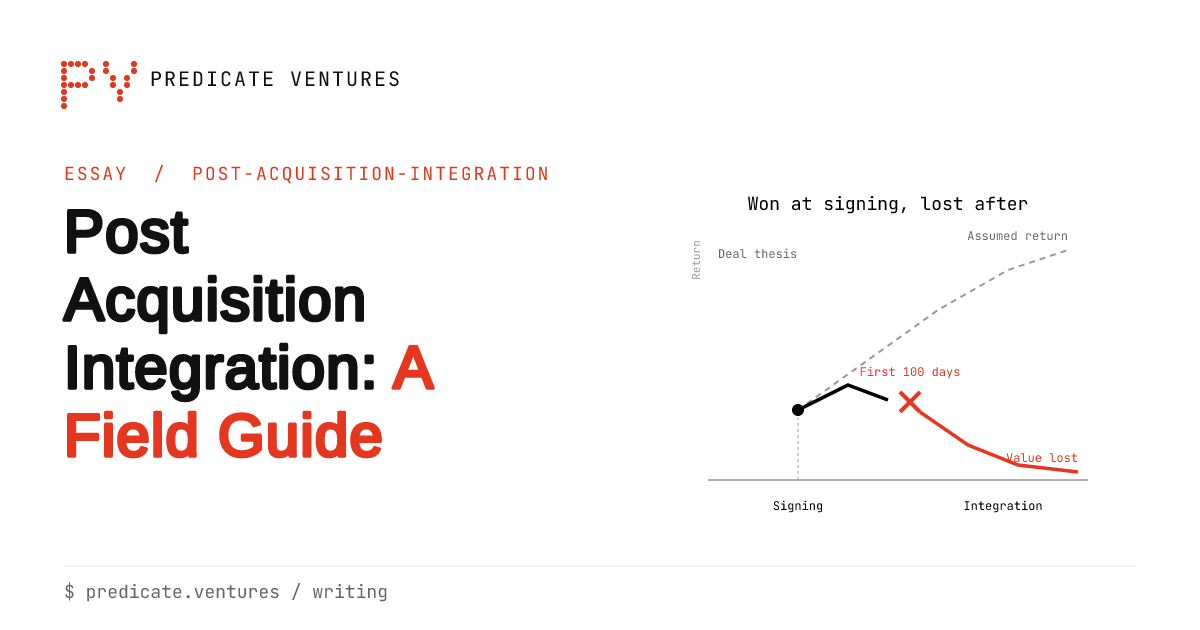
Most deals are won at signing and lost in the months that follow.
Blake Aber · Predicate Ventures · 2026
The gap between the deal and the return
Buyers spend months on diligence and price. They spend far less time on what happens after the wire clears.
That imbalance shows up in results. The purchase thesis assumes synergies, retained talent, and combined systems. Integration is where those assumptions get tested against reality.
The volume of deals makes this more pressing. Global M&A deal value in 2025 rebounded to the second-highest total on record, up 36% versus 2024, according to Bain & Company. More transactions means more integrations that either return capital or destroy it.
Why integration difficulty has risen
The kind of deals being done shapes how hard integration is.
Bain reported that scope deals reached a record share of large 2025 transactions, as companies focused on topline growth and new capabilities. Scope deals are harder to integrate than scale deals. You are combining different customers, product lines, and operating rhythms rather than consolidating the same one.
Private equity added to the pressure. McKinsey reported that private-equity-led deal value grew sharply in 2025, outpacing the broader market. PE owners work on defined hold periods, so integration timelines are compressed by design.
Size compounds the challenge. PitchBook reported that megadeals drove 2025 growth, with billion-dollar-plus transactions generating a majority of global M&A value. Larger deals carry more employees, more contracts, and more systems to reconcile.
Start integration before close
The worst integrations begin the day after signing. The best ones begin during diligence.
Diligence should produce more than a valuation. It should produce a list of what will be combined, what will stay separate, and who owns each decision. Treat the data room as the first draft of the integration plan.
Name an integration leader early. This person is not the deal lead. Deal leads are rewarded for closing; integration leaders are rewarded for what happens over the following year. The two skill sets rarely sit in the same person.
Define the operating model before close. Will the acquired company run standalone, fold into the parent, or something between? That single choice drives every downstream decision about systems, reporting, and headcount.
The first 100 days
The opening period sets the tone for everything after it. Employees, customers, and suppliers are all watching to see whether the new owner is competent.
People decisions come first
Uncertainty drives attrition. The people most likely to leave are often the ones you most want to keep, because they have options.
Decide who stays, who leads, and how compensation works, then communicate those decisions quickly. Silence is read as bad news even when the news is neutral.
Retention packages matter for key staff, but they are not a substitute for clarity about roles. People stay for a defined job, not only for a bonus.
Protect the revenue
Customers do not care about your integration plan. They care whether their contract, their contact, and their pricing hold.
Assign clear account ownership on day one. A customer who does not know who to call is a customer a competitor can reach.
Hold pricing and terms steady through the transition unless there is a strong reason not to. Changing commercial terms during integration signals instability at the worst possible moment.
Set a small number of priorities
Integration teams try to do everything at once and finish nothing. Pick the few outcomes that justify the deal and sequence the rest behind them.
If the thesis was cost synergy, name the specific costs and the dates. If it was cross-selling, name the products, the accounts, and the owners.
Systems and data
Technology integration is slower and more expensive than most plans assume. It is also where synergy estimates quietly erode.
Map the systems on both sides early. Overlapping ERP, CRM, and finance tools each carry migration cost and risk.
Resist the urge to consolidate everything immediately. Some systems can wait; forcing a migration before the business is stable creates outages that cost more than the savings.
Data is the harder problem. Customer records, financial history, and product catalogs rarely match cleanly between two companies. Reconciling them takes time and dedicated staff, and it blocks reporting until it is done.
Measuring whether integration worked
Synergy targets set at signing tend to be forgotten by the second quarter. That is how value leaks without anyone noticing.
Track the synergies as line items with owners and dates. If a target was $20 million in cost reduction by a given quarter, it should appear in a report every month against actuals.
Watch attrition among the acquired staff. High turnover in the first year usually means the integration plan asked more than the organization could absorb.
Watch customer retention with the same discipline. Revenue that walks out during integration is the clearest sign the deal is underperforming its thesis.
What separates good buyers
The record-setting deal environment favors buyers who treat integration as a discipline rather than an afterthought. PitchBook reported that 2025 was the most active M&A year on record by both count and value, with deal count up 12.4% year over year. McKinsey reported that 2025 global deal value finished the year up 43%, exceeding the ten-year average.
More activity does not mean more success. It means more chances to get integration wrong.
The buyers who repeat well share a few habits. They plan integration before signing. They put a dedicated leader in charge. They decide the operating model early and communicate it fast. They protect people and revenue in the first hundred days. They track synergies as concrete line items.
None of these habits are complicated. They are simply harder to sustain than to describe, which is why the gap between the deal price and the return persists across cycles.