AI Governance Consulting: What to Buy and Why
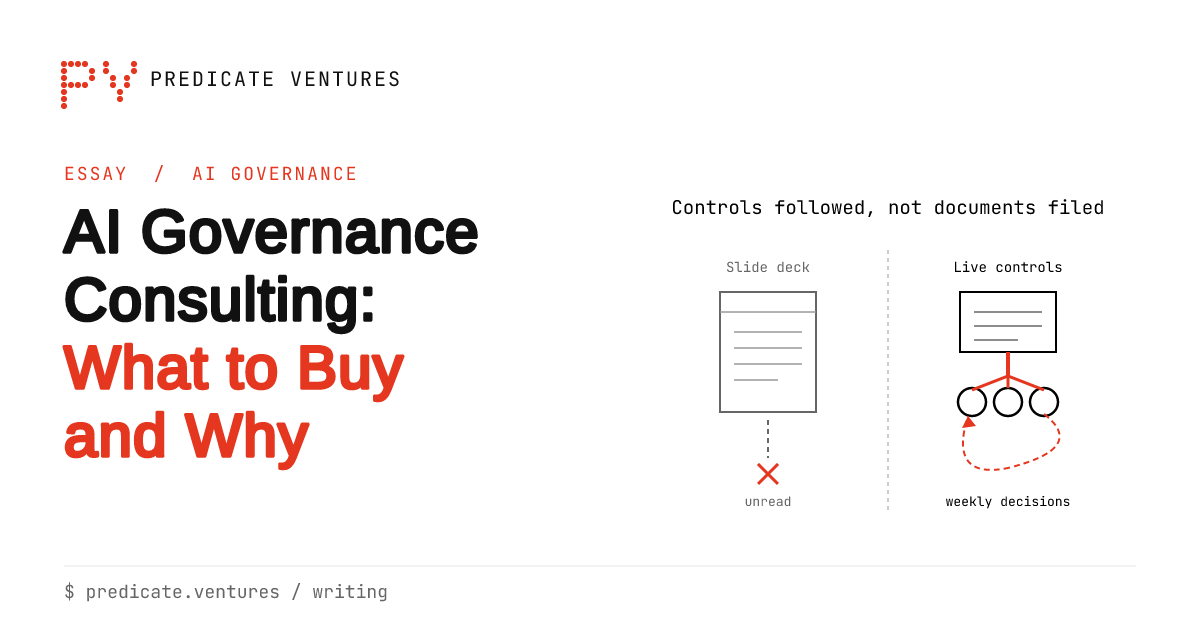
AI governance consulting is worth buying when it produces controls people follow, not documents auditors file.
Blake Aber · Predicate Ventures · 2026
What the market is actually selling
Most AI governance consulting engagements promise the same three deliverables: a risk register, a policy set, and a control framework mapped to a recognized standard.
The quality gap is enormous. Two firms can deliver identical-looking artifacts, and one leaves you with rules that shape how models get built and shipped while the other leaves you with a PDF nobody opens.
The difference is not the framework. It is whether the framework was translated into decisions your teams make every week.
The standard everyone maps to
The reference point for most engagements is the NIST AI Risk Management Framework, released January 26, 2023. AI Risk Management Framework | NIST
The AI RMF organizes work into four functions: Govern, Map, Measure, and Manage. It is voluntary and sector-neutral, which is why consultants like it — it gives structure without prescribing controls that might not fit your business.
NIST followed the framework with the Trustworthy and Responsible AI Resource Center on March 30, 2023, to help organizations put the RMF into practice. AI Risk Management Framework | NIST
If you are deploying generative models, ask specifically about NIST-AI-600-1, the Generative AI Profile released July 26, 2024. AI Risk Management Framework | NIST It addresses risks specific to generative systems, and a consultant who has not read it is selling you 2023.
Where the fee earns out
Governance consulting pays for itself in three places.
Inventory
Most organizations cannot list the AI systems they run. Shadow deployments, vendor features that quietly added a model, and pilots that became production all escape the register.
A good engagement starts by finding what exists, not by writing policy for what should exist. The inventory is the deliverable that surprises executives most, because it usually reveals systems nobody approved.
Risk tiering
Not every model needs the same scrutiny. A demand-forecasting tool and a credit-decision model carry different consequences, and treating them identically wastes effort on one and under-controls the other.
Consultants earn their fee by building a tiering scheme that routes high-consequence systems to review and lets low-stakes tools ship fast. This is the Map function of the AI RMF applied to your actual portfolio.
Control design
The last place value shows up is in controls that fit how your teams already work. Human-review gates, evaluation thresholds, documentation requirements, and monitoring — these only work if they sit inside existing engineering and procurement processes.
A control that requires a new committee meeting will be skipped. A control embedded in a deployment checklist will hold.
How to tell operators from slide decks
The commercial risk in this category is buying advice that never touches production. Here is how to screen.
Ask who implements. If the answer is "we hand off to your team," you are buying a plan, not a system. Firms that stay through implementation have more incentive to design controls that people can follow.
Ask for a sample control, not a sample policy. Policies are generic. A control — the specific gate, the specific threshold, the specific owner — reveals whether the firm thinks about enforcement or just about language.
Ask how they handle model changes. Governance is not a one-time certification. Models get retrained, prompts get edited, vendors push updates. A consultant who cannot describe change management is selling a snapshot of a moving system.
Ask what they measure. The Measure function of the AI RMF is where most engagements go thin, because measurement requires access to model behavior, not just to org charts. Firms that avoid the topic usually cannot do it.
Scope you should insist on
A defensible engagement covers four things.
Governance structure — who owns AI risk, who signs off, and where accountability sits when a model fails. This maps to the Govern function and is where the RMF spends most of its guidance, because structure precedes everything else.
System inventory and tiering — the map of what you run and how much each system matters.
Control library — the actual gates, tied to your development lifecycle rather than to a separate compliance track.
Monitoring and review cadence — how you catch drift, incidents, and vendor changes before they become disclosures.
If a proposal skips inventory or monitoring, it is selling policy and calling it governance.
Build versus buy
Some of this work is worth doing in-house. Inventory, once built, is maintained more cheaply by the teams who own the systems. Control enforcement belongs to engineering permanently.
What consultants add is the initial structure and the outside read on where your exposure sits. They have seen more failure modes than any single company accumulates, and that pattern library is the thing you are actually paying for.
The trap is renting the pattern library forever. Structure the engagement so the framework, the controls, and the review process transfer to your staff. If the consultant becomes a permanent dependency, the governance program is theirs, not yours.
What to pay for
Price the engagement against the deliverables that outlast it: an inventory your team can update, a tiering scheme they understand, and a control set embedded in existing processes.
Do not price it against the length of the policy document. A short policy that governs behavior beats a long one that decorates a shared drive.
AI governance consulting is worth buying when it leaves your organization able to answer three questions without calling the consultant back: what AI do we run, how much does each system matter, and what happens when one of them fails. A firm that gets you there has earned the fee. A firm that hands you a framework and leaves has sold you homework.