Commercial Due Diligence: A Buyer's Field Guide
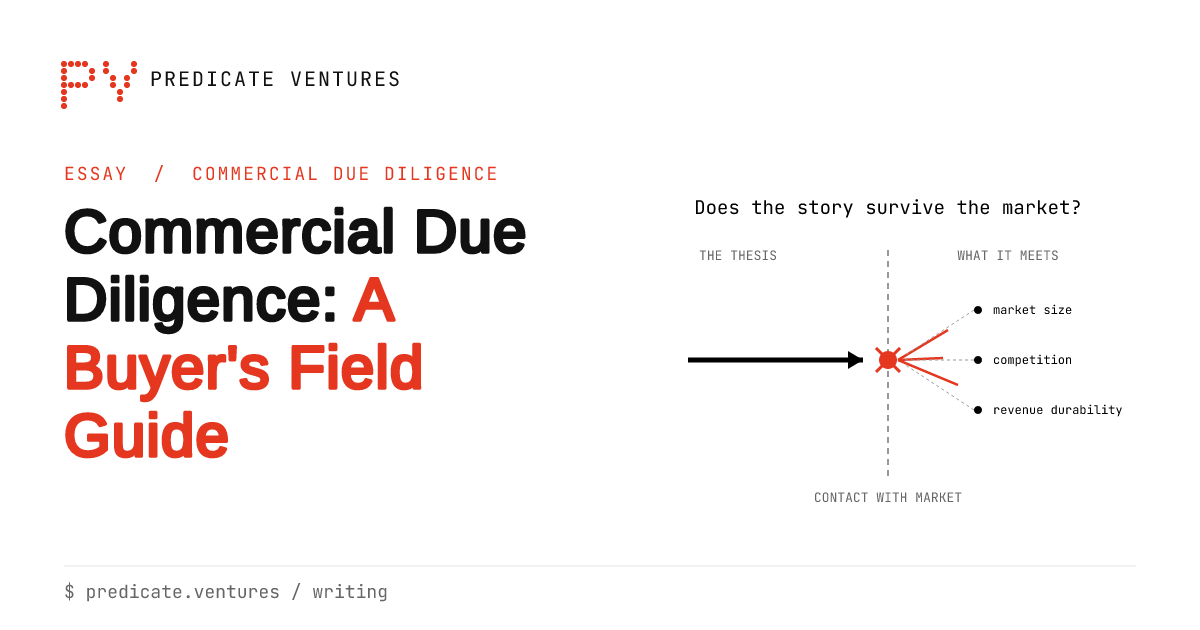
Commercial due diligence tests whether the story behind a deal survives contact with the market it depends on.
Blake Aber · Predicate Ventures
What Commercial Due Diligence Actually Answers
Financial due diligence tells you whether the numbers are real. Commercial due diligence tells you whether they will still be real in five years.
The distinction matters. A clean audit confirms historical performance. It says nothing about whether the market that produced those results is growing, shrinking, or about to be reshaped by a competitor the seller failed to mention.
Commercial due diligence examines the demand side of a business. It asks who buys, why they buy, whether they will keep buying, and what could make them stop.
The output is a judgment on the investment thesis. Either the market supports the return you underwrote, or it does not.
The Four Questions Behind Every Assessment
Most commercial due diligence work reduces to four questions.
How big is the market, and where is it going? Total addressable market matters less than the direction and rate of change. A large market in decline is worse than a small market compounding at twenty percent a year.
Where does the target sit within it? Market share is a starting point. The harder question is whether that share reflects a durable advantage or a temporary lead that competitors can erase.
How loyal are the customers? Revenue that renews without effort is worth more than revenue that must be re-won every year. Retention, concentration, and switching costs define the difference.
What could break the thesis? Every deal has a small number of assumptions that carry most of the risk. The job is to find them and test them.
Sizing the Market Without Fooling Yourself
Seller-provided market figures deserve suspicion. They are usually built to support the price.
A sound market estimate works from the bottom up. Count the customers who could plausibly buy, estimate what they spend, and reconcile that against top-down industry data. When the two approaches disagree by a wide margin, the gap itself is a finding.
Growth rate matters more than absolute size for most investors. A market growing faster than the broader economy gives a business room to expand without taking share from rivals. A flat market forces every gain to come from someone else, which invites price competition.
Segment the market before trusting any aggregate number. A company may operate in a large category while serving a niche that behaves nothing like the whole.
Reading Competitive Position
Competitive position is where optimistic theses tend to fail.
Start with the structure of the market. A few large players with high margins signals barriers to entry. A crowded field with thin margins signals commoditization, regardless of what the pitch deck claims.
Then locate the target inside that structure. Ask what the business does that competitors cannot easily copy. If the answer is "nothing specific," the margins are borrowed and will be reclaimed.
Pricing power is the clearest evidence of position. A company that can raise prices without losing volume holds real advantage. One that discounts to keep customers is defending, not leading.
Watch for competitors that do not yet show up in the seller's framing. Adjacent players, new entrants, and substitute products often pose more threat than the direct rivals everyone tracks.
Customer Evidence Beats Management Narrative
Management will describe a business as they wish it to be seen. Customers describe it as it is.
Customer interviews are the most useful part of commercial due diligence and the most often shortchanged. A structured set of conversations reveals why customers chose the target, what would make them leave, and how they rate alternatives.
The patterns matter more than any single quote. When several customers independently cite the same weakness, that weakness is real. When praise is vague and complaints are specific, treat the complaints as the signal.
Revenue concentration deserves direct attention. If a handful of accounts drive most of the revenue, the health of those relationships determines the outcome of the deal. One departing customer can invalidate the entire model.
Retention data completes the picture. Cohort analysis shows whether customers stay and expand or churn and shrink. Reported retention that management cannot reproduce from raw data is a warning.
Stress-Testing the Thesis
The purpose of the work is not to produce a report. It is to decide whether the price makes sense.
Good commercial due diligence isolates the two or three assumptions that carry the return. Perhaps the thesis requires a certain growth rate, a specific retention level, or the success of a new product line. Name those assumptions and test each one against evidence.
Build the downside explicitly. If growth comes in at half the plan, does the deal still work? If the largest customer leaves, how much of the equity is exposed? A thesis that only functions under favorable conditions is a bet, not an investment.
Separate what the analysis found from what it could not verify. Honest reporting of the unknowns is more valuable than false confidence. Buyers can price uncertainty; they cannot price hidden assumptions.
Timing and Scope
Commercial due diligence usually runs alongside financial and legal workstreams, on a compressed schedule. Two to six weeks is typical, depending on deal size and access.
Scope should follow the thesis. A roll-up in a fragmented market needs deep competitive mapping. A subscription business needs granular retention analysis. Spending equal effort on every question wastes the limited time available.
Access shapes what is possible. Sellers control the flow of information, and the most revealing data often arrives late. Building customer contact into the process early prevents a scramble at the end.
What Good Work Produces
The deliverable is a clear position on the deal, supported by evidence a skeptical partner can check.
It should state whether the market supports the thesis, where the target stands against competitors, how durable the revenue is, and which assumptions carry the most risk. It should also say what remained unknown and why.
The test of quality is simple. Six months after close, does the business behave the way the analysis predicted? Work that survives that comparison earns its cost many times over.
Commercial due diligence does not remove risk from a transaction. It replaces vague optimism with a priced set of bets, which is the most any buyer can ask before writing the check.