Operational Due Diligence: A Practical Guide
Operational due diligence measures whether a fund can run its business, not whether it can pick investments.
Blake Aber · Predicate Ventures
What operational due diligence covers
Investment due diligence asks whether a manager can generate returns. Operational due diligence asks whether the firm can hold the assets, price them honestly, move cash safely, and keep records that survive an audit.
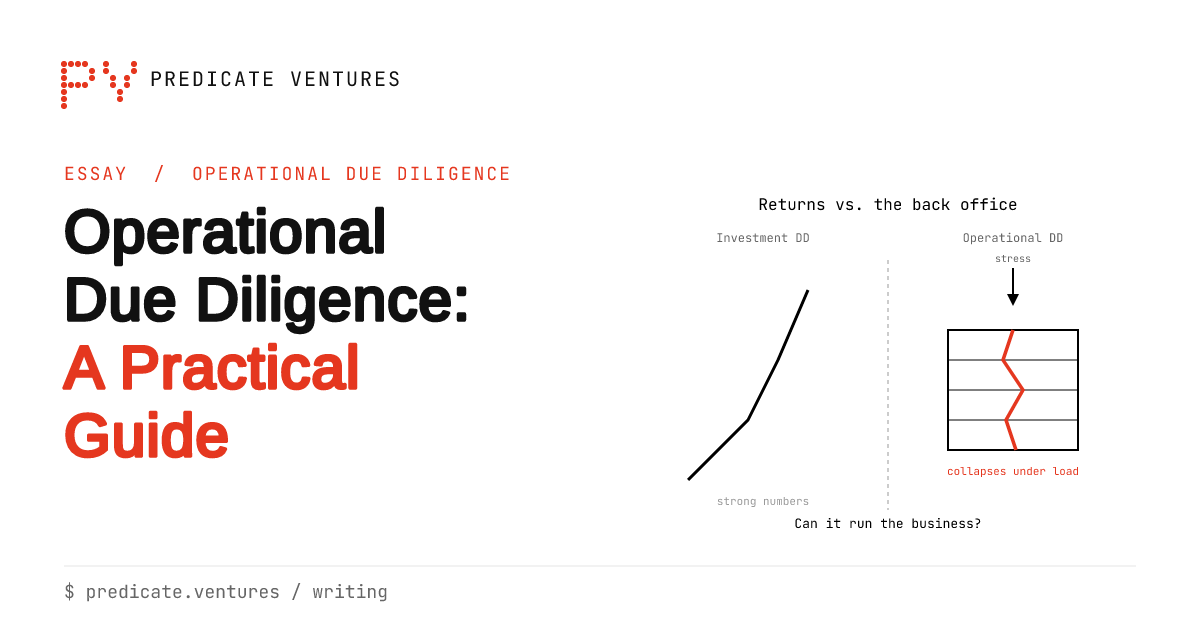
These are separate questions. A fund can post strong numbers while running a back office that would collapse under a redemption wave or a regulatory inquiry. Allocators who skip the operational review learn this the hard way.
The discipline grew out of failures where the strategy was fine but the plumbing was not. Fraud, misvaluation, and cash controls that let one person move money without a second signature — these are operational failures, not investment failures.
Why allocators run it separately
Most institutional allocators keep operational due diligence in a different team than investment analysis. The separation is deliberate.
Investment analysts want the deal to close. They build relationships with managers and grow attached to a thesis. Operational reviewers hold veto power precisely because they carry no incentive to say yes.
At many pensions, endowments, and funds of funds, the operational team can kill an allocation the investment team loves. That structure exists because the two functions pull in opposite directions, and the allocator wants both pressures represented before capital moves.
The core areas under review
Valuation
How does the fund price its positions? Liquid securities are simple. The scrutiny goes to illiquid or hard-to-mark assets, where the manager has discretion over the number that determines its fees.
Reviewers check whether valuation involves an independent party, whether the methodology is documented, and whether the manager can override the process. A fund that marks its own illiquid book with no external check is a warning sign.
Cash controls
Who can move money, and who approves it? The standard is separation of duties: no single person should be able to initiate and authorize a wire.
Reviewers trace the wire process end to end. They confirm that outgoing payments require dual authorization and that account changes trigger callback verification. Most large fund frauds trace back to a manager who controlled cash movement without oversight.
Service providers
The administrator, auditor, custodian, and prime broker form an external check on the manager's claims. Their quality matters.
Reviewers confirm that the administrator is independent and calculates the fund's net asset value rather than rubber-stamping the manager's figures. They verify the auditor is a recognized firm and that the audit opinion is clean. A name-brand administrator on paper means little if the manager still produces the numbers internally.
Compliance and legal
Who handles regulatory filings? Is there a compliance officer, and does that person have authority independent of the portfolio managers?
Reviewers examine the firm's regulatory history, past examinations, and any litigation. They read the fund documents for terms that shift risk to investors — gates, side pockets, suspension rights — and confirm those terms are disclosed and used consistently.
Technology and business continuity
What systems run the trading, accounting, and reconciliation? Are they enterprise tools or spreadsheets held together by one employee?
Reviewers ask about disaster recovery, data backups, and cybersecurity. A fund that cannot operate if its office loses power, or that stores investor data without protection, carries operational risk regardless of returns.
How the review runs
Operational due diligence usually starts with a document request. The manager sends financial statements, service provider agreements, compliance manuals, valuation policies, and organizational charts.
An on-site visit follows. Reviewers want to see the office, meet the operations staff, and observe how the firm actually functions rather than how the pitch deck describes it. Meeting the chief operating officer and the compliance officer in person reveals whether those roles exist in substance or only on the org chart.
Reference calls close the loop. Reviewers contact the administrator, the auditor, and sometimes former employees. Independent confirmation of the manager's claims carries more weight than the manager's own account.
What separates a pass from a fail
No fund is perfect. The question is whether weaknesses are structural or manageable.
A small fund running lean is acceptable if the controls that matter are in place. A large fund with poor cash separation is not, regardless of size. Reviewers weigh severity, not the length of the deficiency list.
The hard veto categories tend to be consistent: no independent administrator, no clean audit, valuation controlled entirely by the manager, and cash movement without separation of duties. Any one of these can end an allocation.
Softer findings — outdated policy documents, thin staffing, dependence on a single key person — usually generate conditions rather than rejections. The allocator asks the manager to fix the issue or accepts a monitoring arrangement.
Ongoing review
Operational due diligence is not a one-time gate. Funds change. Staff leave, service providers get swapped, and controls that held at onboarding can erode.
Allocators re-run the review periodically, often annually for material positions. They watch for turnover in the operations team, changes to the auditor, and any restatement of past figures. A manager who switches administrators quietly, or whose chief financial officer departs abruptly, warrants a fresh look.
For managers raising capital
Managers who understand what allocators test can prepare for it. The operational review is winnable when the firm treats its back office as seriously as its investment process.
Hire an independent administrator early. Engage a recognized auditor. Document the valuation policy and follow it. Build cash controls with real separation of duties before an allocator asks.
The managers who fail operational due diligence rarely do so because they cannot afford controls. They fail because they treated operations as overhead and never built the structure a serious allocator expects to find.
A clean operational review does not win an allocation on its own. But a failed one ends the conversation, no matter how good the returns look.